
Choosing the correct Wates pressure vessel size for a booster pump is important for maintaining stable water pressure and reducing frequent pump starts and stops. A vessel that is too small can cause excessive pump cycling, while simply installing an unnecessarily large vessel may increase cost and space requirements without solving an incorrectly designed system.
So, should you choose a 100L, 200L, 300L, 500L, 750L or 1000L Wates pressure vessel?
The answer depends on several factors, particularly the pump flow rate, start pressure, stop pressure, pre-charge pressure, required pump run time and booster pump control method.
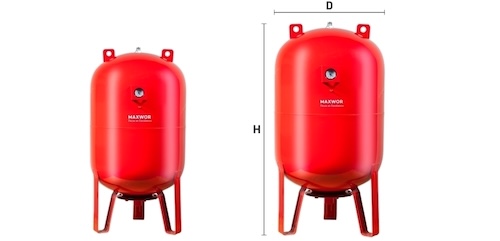
This guide explains how to determine a suitable Wates pressure vessel size for a booster pump system.
Why Does a Booster Pump Need a Pressure Vessel?
A pressure vessel stores a quantity of water under pressure.
When there is a small water demand, water stored in the vessel can enter the system before the booster pump needs to start.
This helps:
- Reduce frequent pump starting and stopping
- Maintain more stable water pressure
- Provide usable water between pump cycles
- Reduce mechanical and electrical stress on the pump
- Improve booster system operation
- Reduce pressure fluctuations
The amount of water available between the pump’s stop and restart pressures is known as drawdown.
Is Pressure Vessel Size the Same as Water Storage Capacity?
No.
This is one of the most important points when selecting a pressure vessel.
A 300-litre Wates pressure vessel does not normally provide 300 litres of usable water.
Part of the vessel volume is occupied by compressed air. Therefore, only a portion of the nominal vessel capacity is available as usable drawdown.
For example:
Vessel nominal capacity: 300 L
Actual drawdown: Depends on the pressure settings and pre-charge.
The exact amount depends primarily on:
- Pre-charge pressure
- Pump start pressure
- Pump stop pressure
- Vessel construction
Therefore, pressure vessel sizing should be based on the required drawdown, not simply the vessel’s litre rating.
What Information Do You Need to Select the Vessel?
Before selecting a Wates pressure vessel, collect the following information:
| Parameter | Example |
|---|---|
| Pump flow | 12 m³/h |
| Pump head | 50 m |
| Start pressure | 3 bar |
| Stop pressure | 5 bar |
| Pre-charge | As specified |
| Number of pumps | 1 / 2 / 3 |
| Control | Fixed speed / VFD |
| Maximum system pressure | Design value |
| Minimum pump run time | Manufacturer requirement |
These values allow the pressure vessel requirement to be calculated more accurately.
Step 1: Find the Pump Flow
Start with the pump’s flow at its actual operating duty point.
Suppose the booster pump capacity is:
6 m³/h
Convert this to litres per minute:
6 m³/h = 6,000 litres/hour
6,000 ÷ 60 = 100 L/min
The pump therefore delivers approximately 100 litres per minute at the stated duty point.
Step 2: Determine the Required Drawdown
For a conventional fixed-speed booster pump, required drawdown can be estimated from:
Required Drawdown = Pump Flow × Required Minimum Run Time
Suppose:
Pump flow = 100 L/min
Required minimum run time = 1 minute
Then:
Required drawdown = 100 × 1 = 100 litres
This means the pressure vessel needs to provide approximately 100 litres of usable drawdown under these assumptions.
It does not mean you should select a 100-litre vessel.
Step 3: Consider Start and Stop Pressure
Now consider the booster pump pressure settings.
For example:
Pump start pressure: 3 bar
Pump stop pressure: 5 bar
The pressure difference affects how much usable water can be obtained from the vessel.
The pre-charge pressure must also be considered.
For illustration:
Pre-charge: 2.8 bar
The actual pre-charge should always be set according to the pressure vessel and booster pump manufacturer’s recommendations.
Step 4: Calculate Approximate Vessel Size
For a simplified theoretical bladder/diaphragm vessel calculation, pressures should be converted from gauge pressure to absolute pressure.
Using approximately 1 bar atmospheric pressure:
Pre-charge absolute: 2.8 + 1 = 3.8 bar
Start pressure absolute: 3 + 1 = 4 bar
Stop pressure absolute: 5 + 1 = 6 bar
An idealized drawdown fraction can be estimated as:
Drawdown Fraction = Pre-charge Absolute × (1 / Start Absolute − 1 / Stop Absolute)
Therefore:
3.8 × (1/4 − 1/6)
≈ 0.317
This means approximately 31.7% of the nominal vessel volume is available as theoretical drawdown under these assumptions.
If the required drawdown is 100 litres:
Required vessel capacity = 100 ÷ 0.317
≈ 316 litres
Therefore, a standard vessel with adequate capacity above the calculated requirement would normally be considered, subject to the actual Wates technical data and booster system requirements.
Wates Pressure Vessel Size Examples
The following table gives a simple comparison using the same illustrative assumptions:
- Start pressure: 3 bar
- Stop pressure: 5 bar
- Pre-charge: 2.8 bar
- Minimum run time: 1 minute
- Conventional fixed-speed pump
| Pump Flow | Flow Rate | Required Drawdown | Calculated Vessel Volume |
|---|---|---|---|
| 3 m³/h | 50 L/min | 50 L | ~158 L |
| 6 m³/h | 100 L/min | 100 L | ~316 L |
| 9 m³/h | 150 L/min | 150 L | ~474 L |
| 12 m³/h | 200 L/min | 200 L | ~632 L |
| 18 m³/h | 300 L/min | 300 L | ~947 L |
| 24 m³/h | 400 L/min | 400 L | ~1,263 L |
Important: This is an illustrative calculation, not a universal Wates sizing chart. Changing the pressure settings, pre-charge, minimum run time or control method changes the required vessel size.
Always confirm the final selection using manufacturer data and the actual booster pump design.
Should You Choose a 100L Wates Pressure Vessel?
A 100-litre Wates pressure vessel can be considered for smaller pumping systems where the required drawdown is relatively low.
It may be used in:
- Small residential water systems
- Small booster pumps
- Applications with low intermittent demand
- Certain VFD systems where only a small buffer volume is required
Do not select a 100L vessel simply because the booster pump itself is small. Check the required drawdown.
When Should You Choose a 200L Wates Pressure Vessel?
A 200-litre Wates pressure vessel provides greater potential drawdown than a 100L vessel.
It may suit:
- Residential booster systems
- Villas
- Small commercial installations
- Moderate-flow pumping systems
Actual suitability depends on the pump duty and pressure settings.
When Should You Choose a 300L Wates Pressure Vessel?
A 300-litre Wates pressure vessel may be used with medium-sized booster systems where greater drawdown is required.
Potential applications include:
- Apartment buildings
- Commercial buildings
- Larger villas
- Twin booster pump systems
However, a 300L vessel is not automatically suitable for every twin-pump system. Calculate the required drawdown first.
When Should You Choose a 500L Wates Pressure Vessel?
A 500-litre Wates pressure vessel may be suitable where the booster system requires higher drawdown capacity.
Applications can include:
- Commercial buildings
- Residential buildings
- Hotels
- Larger fixed-speed booster pump systems
- Industrial water supply applications
The required pressure rating should be checked separately from the vessel volume.
When Are 750L or 1000L Wates Pressure Vessels Required?
Larger vessels such as 750L and 1000L may be considered for high-flow systems or applications requiring greater drawdown.
These can include:
- Large residential buildings
- Hotels
- Commercial developments
- Large fixed-speed booster systems
- Industrial water supply installations
The building type alone should never determine the vessel size. Pump flow and system controls are more important.
What Size Vessel Is Needed for a VFD Booster Pump?
A VFD booster pump requires a different approach.
Variable Frequency Drive systems regulate pump speed to maintain the required system pressure.
Therefore, they may not require the same large drawdown volume as conventional fixed-speed booster pumps.
The pressure vessel in a VFD system may primarily:
- Handle small water demands
- Reduce unnecessary pump starts
- Stabilize system pressure
- Absorb pressure fluctuations
- Improve control response
For this reason, do not automatically apply conventional fixed-speed vessel sizing calculations to a VFD booster pump.
Follow the booster pump or VFD manufacturer’s recommendations.
Does a Twin Booster Pump Need Twice the Vessel Capacity?
Not necessarily.
For example, if you have:
2 × 12 m³/h booster pumps
you should not automatically calculate:
12 + 12 = 24 m³/h
and size the vessel from 24 m³/h.
The correct calculation depends on:
- Pump staging sequence
- Duty/standby or duty/assist operation
- Control method
- Minimum run time
- Pressure settings
- Number of pumps that can operate simultaneously
A duty/standby system, for example, is fundamentally different from two pumps operating together at peak demand.
What Pressure Rating Do You Need?
After determining the vessel volume, check its pressure rating.
Wates pressure vessels may be available in different pressure classes, such as:
10 Bar
Suitable for systems where the maximum allowable operating conditions remain safely below the vessel rating.
16 Bar
Used where the system requires a higher pressure rating.
25 Bar
Used for appropriately designed high-pressure applications.
Never select the vessel pressure rating from the normal operating pressure alone.
Check:
- Pump maximum head
- Pump shut-off pressure
- Static pressure
- System operating pressure
- Possible pressure surges
- Maximum design pressure
The pressure vessel and other system components must be appropriately rated for the maximum pressure they may experience.
Common Pressure Vessel Sizing Mistakes
Avoid selecting a pressure vessel based only on:
- Pump motor kW
- Building height
- Number of apartments
- Vessel litre capacity
- Maximum pump flow
- Number of pumps
Instead, consider the complete hydraulic system.
Another common mistake is assuming:
100L pump requirement = 100L pressure vessel
This is incorrect because nominal vessel capacity is not equal to usable drawdown.
Quick Wates Pressure Vessel Selection Checklist
Before ordering a Wates pressure vessel, confirm:
1. Pump flow: _____ m³/h
2. Pump head: _____ m
3. Start pressure: _____ bar
4. Stop pressure: _____ bar
5. Pre-charge: _____ bar
6. Number of pumps: _____
7. Pump control: Fixed speed / VFD
8. Required minimum run time: _____
9. Maximum system pressure: _____ bar
10. Required vessel pressure rating: 10 / 16 / 25 bar
With this information, the required vessel capacity can be evaluated more accurately.
Wates Pressure Vessel Supplier in UAE
DXB Solutions LLC supplies Wates pressure vessels for booster pump systems in the UAE, with different capacities and pressure ratings available for residential, commercial and industrial water supply applications.
Our team can assist in selecting a suitable Wates pressure vessel based on pump flow, pump head, pressure settings, booster configuration and application requirements.
We supply Wates pressure vessels for projects in Dubai, Sharjah, Ajman, Abu Dhabi, Ras Al Khaimah, Fujairah and across the UAE.
There is no single Wates pressure vessel size that is suitable for every booster pump.
A 100L, 200L, 300L, 500L, 750L or 1000L vessel should be selected according to the required drawdown, pump flow, start and stop pressures, pre-charge, minimum pump run time and booster control method.
For conventional fixed-speed booster pumps, calculate the required drawdown first and then determine the vessel volume capable of providing that drawdown.
For VFD booster systems, follow the pump and controller manufacturer’s specific vessel sizing requirements.
Correct sizing helps reduce pump cycling, stabilize water pressure and improve the overall operation of the booster pump system. For more info contact Wates Pressure Vessel Supplier in UAE or call us at +971 4 2522966.