
Selecting the correct booster pump requires understanding two fundamental parameters: flow rate and pressure. A pump that provides enough pressure but insufficient flow will not meet the building’s water demand, while a pump with excessive flow or pressure can increase energy consumption and create operational problems.
For villas, residential towers, hotels, commercial buildings and industrial facilities in the UAE, the booster pump should be selected according to a calculated duty point — the required flow at the required head.
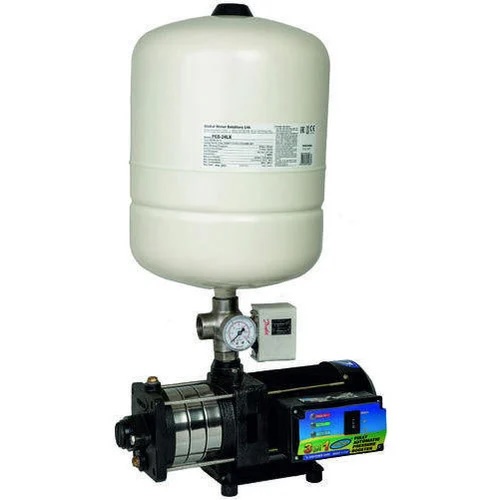
This guide explains how to select a booster pump based on flow and pressure.
What Is Flow Rate in a Booster Pump?
Flow rate represents the quantity of water that the booster pump must deliver over a specific period.
It is commonly expressed in:
- Cubic metres per hour (m³/h)
- Litres per second (L/s)
- Litres per minute (L/min)
For example:
10 m³/h means the pump is capable of delivering 10 cubic metres of water per hour at a particular operating head.
The required flow depends primarily on the building’s water demand.
What Determines the Required Flow?
Several factors influence the required booster pump flow:
- Number of occupants
- Number of bathrooms
- Number of plumbing fixtures
- Building type
- Number of apartments or rooms
- Simultaneous water usage
- Peak water demand
- Commercial or industrial equipment requirements
A villa with four bathrooms will normally require much less flow than a hotel containing hundreds of rooms.
Therefore, pump flow should be calculated from expected simultaneous demand rather than simply from pipe size.
What Is Booster Pump Pressure?
Pressure describes the force available to move water through the distribution system.
It is commonly expressed in:
bar, kPa or psi
Pump manufacturers also commonly specify pump performance in terms of head in metres.
As a useful approximation:
10 metres water head ≈ 1 bar
Therefore:
- 20 m head ≈ 2 bar
- 30 m head ≈ 3 bar
- 40 m head ≈ 4 bar
- 50 m head ≈ 5 bar
- 60 m head ≈ 6 bar
These are approximate conversions and do not by themselves represent the complete system requirement.
Flow and Pressure Must Be Considered Together
One of the most common mistakes when selecting a booster pump is considering only pressure.
A pump does not have one fixed flow and one fixed pressure. Its flow changes depending on the head against which it operates.
For example, a pump might provide:
25 m³/h at 30 metres head
but only:
18 m³/h at 50 metres head
Therefore, saying that you need a “5 bar pump” is not enough.
You need to specify something such as:
Required duty: 20 m³/h @ 50 metres head
This combination of flow and head is known as the duty point.
Step 1: Calculate the Required Flow
Start by determining the building’s peak simultaneous water demand.
Suppose a residential building has a calculated peak demand of:
Flow = 15 m³/h
The booster pump or booster set should be capable of supplying approximately this flow at the required system pressure.
For larger buildings, multiple pumps can share the total demand.
For example, instead of using one large pump, a system may use:
2 × 7.5 m³/h pumps
or a multi-pump arrangement depending on redundancy and operating requirements.
The exact arrangement should be determined from the system design.
Step 2: Determine the Static Head
Static head is the vertical distance that the water must be lifted.
Suppose:
Pump location → highest fixture = 30 metres
Approximately 30 metres of pump head is required simply to overcome the elevation.
However, delivering water to 30 metres elevation with a 30-metre-head pump would leave essentially no useful pressure at the highest outlet.
Additional head is therefore required.
Step 3: Determine the Required Outlet Pressure
The highest or most critical fixture still requires adequate residual pressure.
Suppose the required pressure at the highest outlet is:
2 bar
Approximately:
2 bar ≈ 20 metres head
If the static elevation is 30 metres:
30 m static head + 20 m residual pressure = 50 m
But friction losses must still be added.
Step 4: Calculate Pipe Friction Loss
Water loses pressure as it moves through the piping system.
Friction losses occur through:
- Straight pipes
- Elbows
- Tees
- Valves
- Non-return valves
- Filters
- Water meters
- Other fittings
The amount of friction loss depends on pipe diameter, pipe material, length and water velocity.
Suppose the calculated friction loss is:
8 metres
The total required pump head becomes:
30 m Static Head + 20 m Residual Head + 8 m Friction Loss
Total Dynamic Head = 58 metres
If the required flow is 15 m³/h, the approximate duty point becomes:
15 m³/h @ 58 m head
This is the information required to start selecting the correct booster pump.
Step 5: Consider Available Inlet Pressure
Not every booster pump starts from zero pressure.
If there is already positive pressure at the pump inlet, this may reduce the additional pressure the booster pump needs to generate.
For example, suppose the system requires approximately:
6 bar
and the booster pump has a reliable inlet pressure of:
2 bar
The required pressure increase may be approximately:
6 − 2 = 4 bar
However, actual selection should consider the minimum available inlet pressure and the complete hydraulic system.
For tank-fed systems, the suction conditions must also be evaluated.
Step 6: Plot the Duty Point on the Pump Curve
Once flow and head have been established, check the manufacturer’s pump performance curve.
Suppose your calculated requirement is:
20 m³/h @ 55 m head
Locate:
20 m³/h on the horizontal flow axis.
Then locate:
55 m on the vertical head axis.
The point where these values intersect represents your required duty point.
The selected pump should be capable of operating at or close to this point within an appropriate region of its performance curve.
Step 7: Check the Pump’s Efficiency
Two pumps may both achieve:
20 m³/h @ 55 m
but one may operate more efficiently at that duty point.
Therefore, selection should also consider:
- Pump efficiency
- Motor efficiency
- Motor power
- Operating range
- Best Efficiency Point (BEP)
- Expected operating hours
For pumps operating many hours per day, efficiency can significantly influence electricity costs.
Step 8: Decide Between Single and Multiple Pumps
Flow demand is rarely constant throughout the day.
A residential tower, for example, may have low demand overnight and high demand during morning and evening periods.
Instead of operating one large pump continuously, a booster set can use multiple pumps.
For example:
Pump 1 – Duty
Pump 2 – Assist
Pump 3 – Standby
When demand is low, one pump may operate.
As demand increases, the second pump can assist.
A standby pump provides additional reliability if one of the operating pumps is unavailable.
Step 9: Consider a VFD Booster Pump System
A Variable Frequency Drive (VFD) can adjust pump speed according to water demand.
For example, if the target pressure is:
4.5 bar
the controller monitors system pressure.
When demand increases and pressure begins to fall, pump speed increases.
When demand decreases, pump speed reduces.
In multi-pump systems, additional pumps can be started when one pump can no longer meet the required demand efficiently.
This helps maintain relatively constant water pressure across varying operating conditions.
Example Booster Pump Selection
Consider a residential building with the following requirements:
| Parameter | Requirement |
|---|---|
| Required Flow | 18 m³/h |
| Building Height | 25 m |
| Required Outlet Pressure | 2.0 bar |
| Estimated Friction Loss | 7 m |
| Suction | Water tank |
Convert the required outlet pressure:
2 bar ≈ 20 m head
Calculate the total head:
Static Head = 25 m
Residual Pressure Head = 20 m
Friction Loss = 7 m
Therefore:
Total Head = 25 + 20 + 7 = 52 metres
The approximate booster pump duty becomes:
18 m³/h @ 52 m head
You can now compare pump performance curves and identify a pump capable of achieving this duty efficiently.
This is much more accurate than asking for an 18 m³/h pump or a 5-bar pump alone.
Flow vs Pressure: A Common Misunderstanding
Increasing pressure does not automatically increase the required flow.
Think of them as two separate requirements:
Flow = How much water is needed?
Pressure/Head = How much energy is required to deliver that water through the system?
Both values must be established before selecting the pump.
Avoid Selecting by Motor kW Alone
Another common mistake is requesting:
“I need a 5.5 kW booster pump.”
Motor power alone does not define pump performance.
Different pump designs using the same motor power can produce very different combinations of flow and head.
Instead, provide the supplier with:
Flow: 20 m³/h
Head: 55 m
The booster pump supplier can then identify suitable pump models and verify motor power from the selected pump curve.
Avoid Oversizing Flow and Pressure
Adding excessive safety margins can result in an oversized booster system.
Potential consequences include:
- Excessive pressure
- Increased energy consumption
- Noise
- Frequent cycling
- Higher equipment cost
- Increased stress on valves and piping
- Poor pump operating efficiency
A reasonable design allowance may be appropriate, but it should not replace proper hydraulic calculations.
Booster Pump Selection for Different Buildings
Villas: Selection normally depends on bathrooms, number of floors, simultaneous demand and desired fixture pressure.
Apartment Buildings: Flow calculations should account for multiple apartments and diversity of use. Twin or multi-pump systems are commonly considered.
Hotels: Water demand can change significantly throughout the day, making staged or VFD-controlled systems useful.
High-Rise Buildings: Building height, pressure zoning and maximum allowable pressure on lower floors become especially important.
Commercial Buildings: Selection depends on occupancy, operating hours, fixtures and peak simultaneous demand.
Information to Give a Booster Pump Supplier
When requesting a quotation from booster pump suppliers in UAE, provide as much of the following information as possible:
- Required flow rate
- Required discharge pressure or head
- Building height
- Number of floors
- Available inlet pressure
- Water tank level relative to pump
- Pipe diameter
- Approximate pipe length
- Building type
- Number of users or fixtures
- Water temperature
- Electrical supply
- Number of pumps required
- Duty/standby requirements
- Fixed-speed or VFD control
With the correct information, the supplier can compare suitable pump curves and select an appropriate booster system.
Conclusion
The most important rule when selecting a booster pump is:
Select the pump based on Flow + Head, not pressure or motor power alone.
First calculate the required water flow. Then determine static elevation, required residual pressure and friction losses.
For example:
Flow = 18 m³/h
Static Head = 25 m
Residual Pressure = 20 m
Friction Loss = 7 m
Required Duty Point = 18 m³/h @ 52 m head
Once the duty point has been established, the pump performance curve can be used to identify an appropriate model.
A properly selected booster pump system can provide consistent water pressure, efficient operation and reliable water supply for residential and commercial applications throughout the UAE. For more info contact Booster Pump Suppliers in UAE or call us at +971 4 2522966.