
An end suction centrifugal pump works by converting mechanical energy from a motor into hydraulic energy to move water or other liquids through a piping system.
It is one of the most commonly used pump designs for water transfer, HVAC systems, irrigation, commercial buildings and industrial applications.
Understanding how an end suction centrifugal pump works can help engineers, contractors, facility managers and building owners select, operate and maintain the pump correctly.
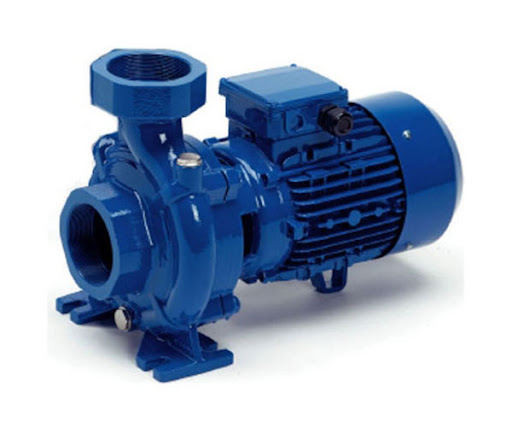
What Is an End Suction Centrifugal Pump?
An end suction centrifugal pump is a centrifugal pump in which the liquid enters the pump through a suction inlet located at the end of the pump casing.
The liquid then passes into the impeller, where rotational energy increases its velocity. The pump casing converts much of this velocity into pressure before the liquid leaves through the discharge connection.
The basic flow process is:
Suction Pipe → Pump Inlet → Impeller Eye → Impeller Vanes → Volute Casing → Discharge Pipe
End suction centrifugal pumps are commonly used for:
- Water transfer
- Commercial buildings
- HVAC systems
- Chilled-water circulation
- Cooling systems
- Irrigation
- Industrial water systems
- General water supply
Main Components of an End Suction Pump
Understanding the main components makes it easier to understand the working principle.
1. Motor
The electric motor provides the mechanical energy required to rotate the pump.
The motor is connected to the pump shaft, either directly or through a coupling depending on the pump design.
2. Pump Shaft
The shaft transfers rotational energy from the motor to the impeller.
The shaft must remain properly aligned to reduce vibration and unnecessary wear.
3. Impeller
The impeller is the main rotating component inside the pump.
As it rotates, its vanes transfer energy to the liquid.
The impeller is responsible for creating the velocity needed to move water through the pump.
4. Suction Inlet
The suction inlet is where liquid enters the pump.
In an end suction pump, this connection is generally positioned at the front or end of the pump casing.
The suction arrangement is important because poor suction conditions can reduce pump performance and increase the risk of cavitation.
5. Volute Casing
The volute casing surrounds the impeller.
Its shape gradually increases the flow area around the impeller, helping convert a portion of the liquid’s velocity into pressure.
The pressurized liquid then moves towards the discharge connection.
6. Discharge Outlet
The discharge outlet is where the liquid leaves the pump and enters the discharge piping system.
Depending on the pump design, the discharge connection may be located at the top of the pump casing.
7. Mechanical Seal
The mechanical seal helps prevent liquid from leaking along the rotating pump shaft.
The seal selection should be suitable for the pumped liquid, temperature and operating pressure.
8. Bearings
Bearings support the rotating shaft and help maintain smooth operation.
Damaged or worn bearings can cause noise, vibration and possible shaft damage.
How an End Suction Centrifugal Pump Works Step by Step
Step 1: The Motor Starts
When electrical power is supplied, the motor starts rotating.
The motor transfers this rotational energy to the pump shaft.
The shaft then rotates the impeller at high speed.
Step 2: The Impeller Creates Low Pressure at the Centre
As the impeller rotates, liquid is moved away from the centre, known as the impeller eye.
This creates a lower-pressure area at the impeller inlet.
The pressure difference between the suction source and the pump inlet causes liquid to move through the suction pipe towards the impeller.
It is important to understand that the pump does not simply “pull” water like a vacuum. The higher pressure acting on the liquid at the suction source helps push the liquid towards the lower-pressure region created at the impeller eye.
Step 3: Water Enters Through the Suction Inlet
Water flows through the suction pipe and enters the pump through the end suction connection.
It then reaches the centre of the rotating impeller.
A properly designed suction system is important for maintaining a stable supply of liquid to the pump.
Step 4: The Impeller Increases Water Velocity
The rotating impeller vanes push the liquid outward from the centre towards the outer edge.
As the liquid moves through the impeller, its velocity increases.
The impeller transfers mechanical energy from the motor to the liquid.
This is the main pumping action of a centrifugal pump.
Step 5: The Volute Converts Velocity into Pressure
After leaving the impeller, the liquid enters the volute casing.
The volute’s expanding flow area helps reduce the liquid velocity and convert part of its kinetic energy into pressure energy.
The liquid therefore leaves the pump at a higher pressure than when it entered.
Step 6: Water Leaves Through the Discharge Outlet
The pressurized water exits through the discharge connection and flows into the piping system.
The pump continues to supply water as long as the motor is operating and suitable suction conditions are maintained.
The actual flow and pressure depend on the pump design and the resistance of the piping system.
Simple Working Principle
The operation can be summarized as:
Motor rotates → Shaft rotates → Impeller rotates → Low pressure develops at impeller eye → Water enters the suction → Impeller accelerates water → Volute increases pressure → Water exits through discharge
This process happens continuously while the pump is operating.
How Does an End Suction Pump Create Pressure?
The pump does not directly create pressure independently of the system.
The impeller adds energy to the liquid, increasing its velocity. The pump casing and piping system convert and resist this energy, resulting in pressure and flow.
The actual operating point depends on the relationship between:
- Pump performance curve
- System curve
- Flow resistance
- Static head
- Pipe friction
- Valves and fittings
For this reason, partially closing a discharge valve changes the system resistance and can change the operating flow and pressure.
The final operating condition should always be checked against the manufacturer’s pump curve.
The Importance of the Pump Curve
Every centrifugal pump has a performance curve showing the relationship between flow and head.
Generally:
Higher Flow → Lower Available Head
Lower Flow → Higher Available Head
For example, a pump may produce a higher head when operating near shut-off conditions and a lower head as flow increases.
The selected operating point should fall within the manufacturer’s recommended operating range.
Whenever practical, the pump should operate reasonably close to its Best Efficiency Point (BEP).
What Happens at the Best Efficiency Point?
The Best Efficiency Point is the operating condition where the pump achieves its highest hydraulic efficiency.
Operating near the BEP can help reduce:
- Energy consumption
- Vibration
- Internal recirculation
- Hydraulic stress
- Component wear
Operating too far away from the recommended range may reduce efficiency and affect the pump’s service life.
Why Does the Pump Need Priming?
Most standard end suction centrifugal pumps cannot effectively pump air.
Before starting, the pump casing and suction line generally need to be filled with liquid unless the system is specifically designed to maintain prime or uses a self-priming pump.
If the pump contains air instead of sufficient liquid, the impeller may rotate without developing the required suction and pressure.
This is commonly referred to as loss of prime.
A pump should not be run dry unless the manufacturer specifically confirms that the pump is designed for dry-running conditions.
The Role of Suction Conditions
Good suction conditions are essential for proper pump operation.
Important factors include:
- Suction pipe diameter
- Pipe length
- Number of bends
- Suction lift
- Water level
- Strainers
- Valve arrangement
- Liquid temperature
- Available NPSH
Poor suction conditions can restrict liquid flow into the pump.
This may cause:
- Reduced flow
- Noise
- Vibration
- Cavitation
- Mechanical seal problems
- Reduced pump life
What Is Cavitation?
Cavitation occurs when local pressure in the liquid falls sufficiently low for vapour bubbles to form.
When these bubbles move into higher-pressure areas, they collapse.
This can cause:
- Noise
- Vibration
- Reduced performance
- Impeller erosion
- Pump damage
Correct suction design and sufficient NPSH Available are important for reducing the risk of cavitation.
End Suction Pump Flow and Head
An end suction pump is selected according to the required combination of:
Flow + Head
For example:
40 m³/h at 30 m head
This does not mean that every pump with a 30 m maximum head is suitable.
The selected pump must provide 40 m³/h at 30 m head according to its actual performance curve.
Pump selection should also consider efficiency, NPSH, motor power and the recommended operating range.
Common Applications of End Suction Centrifugal Pumps
End suction centrifugal pumps are widely used for:
Building Water Supply
They can transfer water between tanks and supply water to building systems.
HVAC and Chilled Water
End suction pumps are commonly used for water circulation in HVAC systems, depending on the required flow and head.
Irrigation
They can supply water to irrigation networks for landscaping and agricultural applications.
Industrial Applications
They are used for process water, cooling water and general liquid transfer.
Water Transfer
End suction pumps are suitable for transferring clean water between tanks, reservoirs and other locations.
Commercial Buildings
They can be used in hotels, offices, shopping centres and other facilities for water circulation and transfer applications.
End Suction Pump vs Other Pump Types
End suction pumps are commonly selected when a relatively simple and accessible centrifugal pump design is suitable.
However, other pump types may be more appropriate depending on the application.
End Suction vs Vertical Multistage Pump
Vertical multistage pumps are often selected where higher pressure is required within a compact footprint.
End Suction vs Submersible Pump
A submersible pump operates while immersed in the liquid and is commonly used for borewells, drainage and sewage applications.
End Suction vs Split Case Pump
Split case pumps are often considered for larger flow applications and can offer different maintenance and hydraulic characteristics.
The correct pump depends on the required flow, head, liquid and installation conditions.
How to Maintain an End Suction Centrifugal Pump
Regular maintenance can help maintain reliable operation.
Inspect the pump for:
- Mechanical seal leakage
- Abnormal vibration
- Unusual noise
- Bearing condition
- Motor temperature
- Coupling alignment
- Suction pressure
- Discharge pressure
- Reduced flow
- Impeller wear
Maintenance should follow the manufacturer’s instructions and the actual operating conditions.
Common End Suction Pump Problems
Some common problems include:
Pump Runs but Does Not Deliver Water
Possible causes may include:
- Pump not primed
- Air in suction line
- Closed suction valve
- Blocked suction strainer
- Incorrect rotation
- Excessive suction lift
Low Flow
Possible causes may include:
- Blocked impeller
- Pipe restriction
- Excessive system resistance
- Incorrect pump selection
- Worn components
Excessive Noise or Vibration
Possible causes may include:
- Cavitation
- Bearing wear
- Misalignment
- Loose mounting
- Air entering the suction line
Mechanical Seal Leakage
Possible causes may include:
- Worn seal faces
- Dry running
- Incorrect seal selection
- Excessive vibration
- Shaft or alignment problems
A detailed inspection is recommended before replacing components.
End Suction Centrifugal Pumps in UAE
End suction centrifugal pumps are widely used across the UAE for commercial buildings, HVAC systems, water transfer, irrigation and industrial applications.
When selecting an end suction pump in UAE, consider the required flow, total head, pump efficiency, motor power, NPSH, material of construction and available technical support.
DXB Solutions LLC can assist customers with end suction pump selection and supply for residential, commercial and industrial applications.
Providing the required flow, head, application, liquid details and operating conditions helps ensure that the pump is selected according to the actual system requirements. For more info contact Water Pump Suppliers in UAE or call us at +971 4 2522966.