
One of the most common questions when selecting a pressure vessel is:
How much water does the vessel actually hold?
A common misunderstanding is that a 100-litre pressure vessel provides 100 litres of usable water, or that a 500-litre vessel provides 500 litres.
In normal operation, this is not the case.
A pressure vessel contains both water and compressed air. Only a portion of its nominal capacity is available as usable water between the pump’s stop and start pressures. This usable quantity is normally referred to as drawdown.
Therefore:
Pressure Vessel Size ≠ Usable Water Capacity
Understanding this difference is important when selecting a pressure vessel for a water pump or booster pump system.
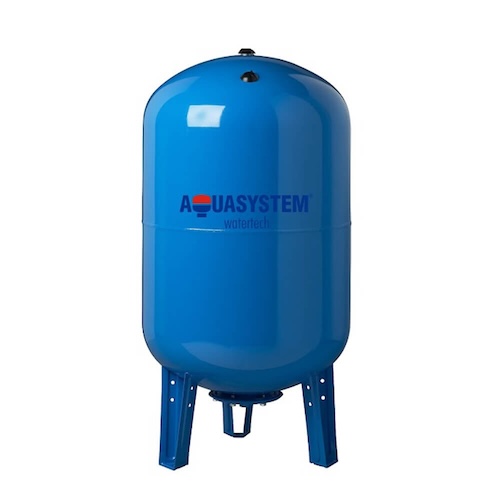
What Does Pressure Vessel Capacity Mean?
When a pressure vessel is described as:
- 60 litres
- 100 litres
- 200 litres
- 300 litres
- 500 litres
- 750 litres
- 1000 litres
the figure refers approximately to the vessel’s nominal internal volume, not the amount of water that will normally be delivered between pump cycles.
For example:
100L pressure vessel ≠ 100L usable water
The vessel requires an air cushion to operate.
As water enters the vessel, this air is compressed. When water demand occurs, the compressed air expands and pushes water back into the system.
What Is Drawdown?
Drawdown is the amount of usable water that can be discharged from a pressure vessel as system pressure falls from the pump’s cut-out pressure to its cut-in pressure.
For example:
Pump cut-out = 4 bar
Pump cut-in = 3 bar
The amount of water delivered by the vessel while pressure falls from 4 bar to 3 bar is the vessel’s drawdown under those operating conditions.
Drawdown depends primarily on:
- Nominal vessel capacity
- Pre-charge pressure
- Pump cut-in pressure
- Pump cut-out pressure
This means the same 100L vessel can provide different drawdown at different pressure settings.
Why Isn’t the Entire Vessel Filled with Water?
A pressure vessel needs compressed air to store energy.
Water is practically incompressible under normal pumping-system conditions, while air is compressible.
When the pump sends water into the vessel:
Water volume increases → Air volume decreases → Air pressure increases
When water is used:
Compressed air expands → Water is pushed out → System pressure decreases
Without an adequate air cushion, the vessel would provide very little useful pressure storage.
Example: 100L Pressure Vessel
Consider a theoretical 100L bladder vessel operating with:
Pre-charge = 2.8 bar gauge
Pump cut-in = 3.0 bar gauge
Pump cut-out = 4.0 bar gauge
For gas-law calculations, gauge pressures must first be converted approximately to absolute pressure:
Pre-charge = 3.8 bar absolute
Cut-in = 4.0 bar absolute
Cut-out = 5.0 bar absolute
Using an idealized gas-law calculation, the drawdown fraction is approximately:
3.8 × (1/4 − 1/5)
= 0.19
Therefore, theoretical drawdown is approximately:
100 × 0.19 = 19 litres
So under these assumed conditions:
100L nominal vessel → approximately 19L theoretical drawdown
This example clearly shows why a 100L pressure vessel should not be considered a 100L usable water tank.
Actual performance should always be checked against the vessel manufacturer’s published drawdown data.
Approximate Water Drawdown by Vessel Size
Using the same theoretical operating conditions:
Pre-charge: 2.8 bar
Cut-in: 3.0 bar
Cut-out: 4.0 bar
the approximate theoretical drawdown would be:
| Nominal Vessel Size | Approx. Theoretical Drawdown |
|---|---|
| 60 L | 11.4 L |
| 100 L | 19 L |
| 200 L | 38 L |
| 300 L | 57 L |
| 500 L | 95 L |
| 750 L | 142.5 L |
| 1000 L | 190 L |
Important: These values are examples based on the stated assumptions. They are not universal capacities.
Different pre-charge and operating pressures will produce different drawdown values.
Always use the specific manufacturer’s technical data for final selection.
How Much Water Does a 60L Pressure Vessel Hold?
A 60L vessel does not normally provide 60 litres of usable water.
Using the example operating conditions above, theoretical drawdown would be approximately:
11.4 litres
Actual drawdown depends on the vessel model and pressure settings.
How Much Water Does a 100L Pressure Vessel Hold?
Under the same example:
100L vessel → approximately 19L theoretical drawdown
Changing the pre-charge, cut-in or cut-out pressure will change this value.
Therefore, when purchasing a 100L pressure vessel, do not assume that you will receive 100 litres of usable water between pump cycles.
How Much Water Does a 200L Pressure Vessel Hold?
Under the same theoretical conditions:
200L vessel → approximately 38L drawdown
A 200L vessel therefore provides approximately twice the drawdown of a 100L vessel when both operate under identical idealized pressure conditions.
How Much Water Does a 300L Pressure Vessel Hold?
Using the same example:
300L vessel → approximately 57L drawdown
This may be suitable for certain booster pump systems depending on pump flow, required minimum run time and control method.
How Much Water Does a 500L Pressure Vessel Hold?
Under the example operating conditions:
500L vessel → approximately 95L theoretical drawdown
This is a useful illustration for larger booster pump applications.
A customer requiring approximately 100 litres of drawdown could therefore require a nominal vessel around this capacity range—or larger—depending on the actual pressure settings and manufacturer’s data.
How Much Water Does a 750L Pressure Vessel Hold?
Using the same assumptions:
750L vessel → approximately 142.5L theoretical drawdown
The actual usable volume should be verified against the manufacturer’s drawdown chart.
How Much Water Does a 1000L Pressure Vessel Hold?
Under the same theoretical operating conditions:
1000L vessel → approximately 190L theoretical drawdown
Again, this does not mean every 1000L pressure vessel will provide 190 litres of usable water.
Pressure settings determine the actual drawdown.
Why Does Drawdown Change with Pressure?
The amount of water stored and released depends on how much the air cushion is compressed.
Changing any of the following affects drawdown:
Pre-Charge Pressure
The initial air pressure determines the starting condition of the air chamber.
Cut-In Pressure
This determines when the pump restarts.
Cut-Out Pressure
This determines how far the vessel is charged before the pump stops.
Pressure Differential
The difference between cut-in and cut-out pressure influences how much water can be released between pump cycles.
This is why a vessel cannot be assigned one universal usable-water figure without specifying its operating conditions.
Pressure Vessel Capacity vs Drawdown
It is useful to understand the terminology:
Nominal Capacity
The approximate total internal volume of the pressure vessel.
Water Volume
The quantity of water physically present inside the vessel at a particular operating pressure.
Drawdown
The quantity of usable water discharged between the pump’s cut-out and cut-in pressures.
For pump-system selection, drawdown is usually more useful than simply asking how much water is inside the vessel at one moment.
How Much Water Is Inside the Vessel at Maximum Pressure?
This is different from drawdown.
At the pump’s cut-out pressure, the vessel contains a certain quantity of water. When pressure falls to cut-in pressure, some water still normally remains inside the vessel.
Therefore:
Water inside vessel at cut-out ≠ Drawdown
Drawdown is only the difference between the water volume at the two operating pressures.
This distinction is important when reading pressure vessel technical data.
Does a Bigger Pressure Vessel Hold More Usable Water?
Under the same pressure and pre-charge conditions, yes—a larger vessel generally provides proportionally more drawdown.
For example, using the same theoretical conditions:
100L → approximately 19L drawdown
200L → approximately 38L
500L → approximately 95L
However, selecting the largest possible vessel is not necessarily required.
The vessel should be sized according to:
- Pump flow
- Required minimum run time
- Pump starting frequency
- Cut-in pressure
- Cut-out pressure
- Pre-charge
- Pump control method
How Much Drawdown Does a Booster Pump Need?
A simple starting relationship for some conventional systems is:
Required Drawdown = Pump Flow × Required Minimum Run Time
For example:
Pump flow:
100 L/min
Required minimum run time:
1 minute
Required drawdown:
100 × 1 = 100 litres
If the vessel provides approximately 19% drawdown under the assumed pressure conditions:
Required nominal volume ≈ 100 ÷ 0.19
≈ 526 litres
This illustrates why a pump requiring 100 litres of drawdown may need a pressure vessel considerably larger than 100 litres.
Final sizing should be verified against the pump and pressure-vessel manufacturers’ requirements.
Does a VFD Booster Pump Need the Same Drawdown?
Not necessarily.
A Variable Frequency Drive changes pump speed according to system demand.
In many VFD booster systems, the pressure vessel primarily acts as a smaller buffer for:
- Very low water demand
- Pressure stabilization
- Reducing unnecessary starts
- Short transient conditions
- Supporting smooth control
Therefore, VFD systems may use smaller pressure vessels than comparable conventional fixed-speed systems.
Follow the booster pump or VFD manufacturer’s vessel-sizing recommendations.
What Happens If the Pressure Vessel Has Very Little Water?
A pressure vessel containing little usable water may indicate several possibilities, including:
- Incorrect pre-charge
- Excessive pre-charge
- Damaged bladder
- Incorrect pump pressure settings
- Undersized vessel
- System operating outside the intended pressure range
The complete system should be checked before assuming the vessel itself is defective.
What Happens If a Pressure Vessel Becomes Waterlogged?
A pressure vessel can lose its effective air cushion because of bladder failure, loss of air charge or another internal problem.
A waterlogged vessel may cause:
- Very low drawdown
- Frequent pump starts
- Rapid pressure fluctuations
- Short cycling
- Poor booster pump performance
The pre-charge and bladder condition should be inspected if these symptoms occur.
How to Choose the Correct Pressure Vessel Capacity
Before selecting a pressure vessel, determine:
Pump flow: ___ L/min or m³/h
Required minimum run time: ___ seconds/minutes
Cut-in pressure: ___ bar
Cut-out pressure: ___ bar
Pre-charge: ___ bar
Pump control: Fixed speed / VFD
Maximum system pressure: ___ bar
From these values, calculate the required drawdown and compare it with the manufacturer’s pressure-vessel drawdown table.
Pressure Vessel Suppliers in UAE
DXB Solutions LLC supplies pressure vessels for booster pumps, water pumps and water supply systems across the UAE.
Available capacities can include:
60L – 100L – 200L – 300L – 500L – 750L – 1000L – 1500L
Pressure ratings can include:
10 bar – 16 bar – 25 bar
Available brands can include Wates, Aquasystem, CIMM and Challenger, subject to model and stock availability.
Pressure vessels can be selected for residential, commercial and industrial water pump applications according to required capacity, pressure rating and system operating conditions.
Frequently Asked Questions
Does a 100L pressure vessel hold 100 litres of usable water?
No. A 100L vessel has approximately 100 litres of nominal internal capacity, but only a portion is available as usable drawdown between pump cycles.
How much usable water is in a 100L pressure vessel?
It depends on pre-charge, cut-in and cut-out pressure. Under an example of 2.8 bar pre-charge, 3 bar cut-in and 4 bar cut-out, idealized theoretical drawdown is approximately 19 litres.
How much usable water is in a 500L pressure vessel?
Under the same example conditions, theoretical drawdown is approximately 95 litres. Actual manufacturer data should be used for final selection.
Is drawdown the same as the water inside the vessel?
No. Drawdown is the amount of water discharged between cut-out and cut-in pressure. Some water may remain inside the vessel when the pump reaches its cut-in pressure.
Does higher vessel capacity mean more drawdown?
Under identical operating pressures and vessel characteristics, increasing nominal vessel capacity generally increases available drawdown proportionally.
Why does my pressure vessel provide very little water?
Possible causes include incorrect pre-charge, a damaged bladder, inappropriate pressure settings, an undersized vessel or another system problem.
A pressure vessel does not provide its entire nominal volume as usable water.
A 100L pressure vessel does not normally provide 100L of drawdown, and a 500L pressure vessel does not normally provide 500L of drawdown.
The usable water quantity depends on:
Vessel Capacity + Pre-Charge + Cut-In Pressure + Cut-Out Pressure
The key figure for booster pump selection is therefore usually drawdown, not simply nominal vessel capacity.
Always verify the required drawdown against the specific pressure vessel manufacturer’s technical data before making the final selection. For more info contact Pressure Vessel Suppliers in UAE or call us at +971 4 252 2966.