
Choosing the correct solar water heater capacity for a villa is important for ensuring sufficient hot water without unnecessarily oversizing the storage tank and solar collector system.
A common mistake is to select a solar water heater only according to the number of bedrooms or bathrooms. A better approach is to estimate the villa’s daily hot-water demand, consider peak usage, and then select suitable storage and collector capacity.
For UAE villas, factors such as household size, shower habits, incoming water temperature, required hot-water temperature, roof space, solar availability and backup heating should all be considered.
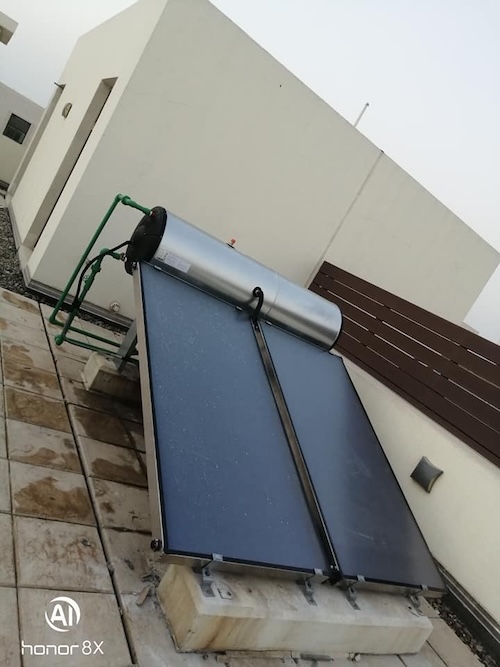
Why Solar Water Heater Capacity Matters
If the solar water heater is too small, occupants may run out of hot water during periods of high demand. The electric backup heater may also operate more frequently.
If the system is unnecessarily large, it can increase:
- Equipment cost
- Roof-space requirement
- Installation cost
- Stored-water heat losses
- System complexity
The objective is therefore to select a system that reasonably matches the villa’s actual hot-water requirement.
Step 1: Determine the Number of Occupants
Start with the number of people regularly living in the villa.
For example:
Villa occupants = 5 people
However, don’t stop here.
The number of occupants provides a starting point, but actual consumption depends heavily on how those occupants use hot water.
Step 2: Estimate Daily Hot-Water Consumption
Hot water may be required for:
- Showers
- Wash basins
- Kitchen use
- Cleaning
- Other domestic purposes
For preliminary residential calculations, you can estimate consumption on a per-person-per-day basis, but the allowance should be adjusted to the actual household.
For example, if you provisionally assume:
40 litres of hot water/person/day
for five occupants:
5 × 40 = 200 litres/day
The estimated daily hot-water requirement would be:
200 litres/day
This is only a preliminary sizing figure—not an automatic instruction to purchase a 200-litre tank.
Step 3: Calculate Demand from Actual Shower Usage
A more detailed approach is to estimate actual fixture consumption.
Suppose:
Shower flow = 8 L/min
Average shower duration = 7 minutes
Then:
Water per shower = 8 × 7
= 56 litres
For five showers:
56 × 5 = 280 litres
But this represents approximately 280 litres of mixed shower water, not necessarily 280 litres of stored hot water.
Cold water is normally mixed with hotter stored water at the shower.
This distinction is important when calculating storage capacity.
Step 4: Account for Hot and Cold Water Mixing
Suppose:
Stored hot water = 60°C
Cold water = 25°C
Required shower water = 40°C
A simplified mixing calculation is:
Hot-water fraction = (Required temperature − Cold-water temperature) ÷ (Stored temperature − Cold-water temperature)
Therefore:
Hot-water fraction = (40 − 25) ÷ (60 − 25)
= 15 ÷ 35
≈ 0.43
So approximately 43% of the mixed shower water would come from the 60°C hot-water supply under these simplified assumptions.
For 280 litres of mixed shower water:
280 × 0.43 ≈ 120 litres
So the showers would consume approximately 120 litres of 60°C hot water under those assumed conditions.
Actual performance varies with inlet temperature, stored-water temperature, heat loss, mixing behaviour and system design.
Step 5: Add Other Hot-Water Requirements
Showers aren’t the only demand.
Suppose our five-person villa also uses approximately:
Showers: 120 L equivalent hot water
Wash basins: 20 L
Kitchen/other use: 25 L
Estimated requirement:
120 + 20 + 25 = 165 litres/day
You can then include a reasonable design allowance rather than sizing exactly to the theoretical number.
For example:
165 × 1.15 ≈ 190 litres
This indicates that a system around the 200-litre class may warrant evaluation for this example.
The final selection should still consider collector capacity and actual usage pattern.
Step 6: Consider Peak Demand
Daily consumption alone isn’t enough.
Imagine two five-person households.
Villa A
Everyone showers at different times:
6:00 AM
7:00 AM
10:00 AM
5:00 PM
9:00 PM
Villa B
Four people shower between:
6:30 AM–7:30 AM
Both households could consume a similar quantity of hot water during the day, but Villa B has much higher peak demand.
Storage capacity must therefore be capable of supporting periods when several occupants need hot water within a short time.
Step 7: Consider the Number of Bathrooms
A villa with five occupants and two bathrooms may have a different peak demand from a villa with five occupants and five bathrooms.
Ask:
How many showers could realistically operate simultaneously?
If several bathrooms are likely to be used together, both hot-water storage and the plumbing system must be capable of meeting that demand.
Step 8: Select the Solar Storage Capacity
Once the approximate hot-water demand is known, the storage tank can be evaluated.
For illustration:
| Estimated demand | Capacity to investigate |
|---|---|
| Lower residential demand | 150 L class |
| Moderate residential demand | 200 L class |
| Higher residential demand | 300 L class |
| Above typical residential range | Engineered/larger system |
These are not fixed person-to-tank sizing rules.
A high-consumption three-person household could require more storage than a low-consumption five-person household.
Step 9: Calculate the Solar Collector Requirement
A solar water heater isn’t just a storage tank.
The collector must capture enough solar energy to heat the stored water.
Therefore:
Solar water heater sizing = Storage capacity + Collector capacity
For example, Ariston’s Middle East KAIROS THERMO GR-2 range currently pairs its nominal capacities as follows:
150 L → 1 collector → 2.04 m² gross collector area
200 L → 1 collector → 2.04 m² gross collector area
300 L → 2 collectors → 4.08 m² gross collector area
This demonstrates why simply saying “I need a 300-litre tank” isn’t a complete solar-system specification.
Step 10: Consider Available Roof Space
Before finalizing capacity, confirm that the villa has sufficient usable roof space.
Consider:
- Collector dimensions
- Number of collectors
- Tank and frame
- Collector orientation
- Shading
- Parapet walls
- Water tanks
- AC equipment
- Maintenance access
A larger solar system may require substantially more usable collector area.
Example: Solar Water Heater Calculation for a 4-Person Villa
Suppose a villa has:
Occupants: 4
Bathrooms: 3
Average showers/person/day: 1
Shower flow: 8 L/min
Average shower: 7 minutes
Mixed shower water:
4 × 8 × 7 = 224 litres/day
Assume:
Hot-water storage temperature = 60°C
Cold-water temperature = 25°C
Shower temperature = 40°C
Hot-water fraction:
(40 − 25) ÷ (60 − 25)
= 0.43
Therefore:
224 × 0.43 ≈ 96 litres
Assume another:
30 litres/day
of equivalent hot-water demand for wash basins, kitchen and other uses.
Total:
96 + 30 = 126 litres/day
Add a 15% preliminary allowance:
126 × 1.15 ≈ 145 litres
This calculation suggests that a 150-litre class system could be evaluated for this particular usage example.
However, if occupants take longer showers, use rain showers with higher flow rates, or frequently use multiple bathrooms simultaneously, a larger system may be appropriate.
Example: Solar Water Heater Calculation for a 6-Person Villa
Suppose:
6 occupants
8 L/min shower
8-minute average shower
Mixed shower water:
6 × 8 × 8
= 384 litres/day
Using the same simplified temperature assumptions:
384 × 0.43 ≈ 165 litres of hot water
Add approximately:
40 litres
for other domestic hot-water use:
165 + 40 = 205 litres
Add a 15% preliminary allowance:
205 × 1.15 ≈ 236 litres
In this example, a larger residential system, potentially around the 300-litre class, should be evaluated rather than automatically choosing 200 litres.
Again, actual demand and the selected manufacturer’s system specifications should determine the final choice.
Quick Calculation Formula
For a preliminary villa calculation:
Shower Demand
Number of people × Showers/day × Shower flow (L/min) × Shower duration (min)
Then calculate the approximate hot-water fraction:
Hot-Water Fraction
(Required mixed-water temperature − Cold-water temperature) ÷ (Stored hot-water temperature − Cold-water temperature)
Then:
Stored Hot-Water Requirement
Mixed-water demand × Hot-water fraction
Add other hot-water consumption and an appropriate design allowance.
This gives you a better starting point than simply using a fixed number of litres per person.
What About a Villa with a Bathtub?
Bathtubs can significantly increase peak hot-water demand.
If the villa regularly uses:
- Large bathtubs
- Jacuzzi tubs
- High-flow rain showers
- Multiple simultaneous showers
these demands should be calculated separately.
A villa with only three occupants could still require a relatively large hot-water system if it contains high-consumption fixtures.
What About Maid’s Rooms and Guest Rooms?
Include everyone who regularly uses the villa’s hot-water system.
For example:
Family: 5 people
Domestic staff: 2 people
Regular total: 7 people
Don’t calculate the solar water heater only for the five family members if seven people routinely consume hot water.
For guest rooms, consider the expected frequency and duration of guest occupancy rather than assuming maximum occupancy every day.
How UAE Conditions Affect Sizing
The UAE has favourable solar availability, but system design still needs to consider seasonal and operating variations.
Solar-water-heater performance can be affected by:
- Solar radiation
- Collector orientation
- Dust accumulation
- Shading
- Incoming water temperature
- Hot-water demand
- Collector cleanliness
- Tank insulation
- Weather conditions
A system shouldn’t be undersized on the assumption that UAE sunshine will always compensate for insufficient storage.
Don’t Forget Backup Heating
Solar energy may not always be sufficient to satisfy the complete hot-water requirement.
A properly configured backup heater can provide supplementary heating when necessary.
However, if backup heating is operating frequently because the solar system is too small for normal demand, the system sizing should be reviewed.
Solar Water Heater Capacity for Large Villas
For larger villas, don’t rely solely on a simple litres-per-person calculation.
Carry out a more detailed assessment covering:
Number of occupants
↓
Fixture flow rates
↓
Usage duration
↓
Simultaneous demand
↓
Daily hot-water requirement
↓
Required storage
↓
Collector capacity
↓
Backup heating
↓
Hot-water circulation
Large villas may require multiple collectors or a specifically engineered solar hot-water solution.
Information Needed to Size a Villa Solar Water Heater
Before requesting a system selection, prepare:
Number of occupants: ___
Number of bathrooms: ___
Number of showers/day: ___
Shower flow: ___ L/min
Average shower duration: ___ minutes
Simultaneous showers: ___
Bathtubs/Jacuzzis: ___
Desired hot-water temperature: ___ °C
Available roof area: ___ m²
Water pressure: ___ bar
Hot-water circulation: Yes / No
Backup heater: Yes / No
With this information, the solar water heater can be sized much more accurately.
Solar Water Heater Supplier in UAE
DXB Solutions LLC supplies solar water heaters for villas in the UAE, including systems for different residential hot-water requirements.
System selection can be based on:
- Number of occupants
- Daily hot-water consumption
- Number of bathrooms
- Peak demand
- Storage capacity
- Solar collector requirements
- Roof conditions
- Water pressure
- Backup heating
- Hot-water circulation
Rather than selecting a solar water heater based only on tank litres, the complete hot-water requirement should be evaluated.
The best way to calculate solar water heater capacity for a villa is to start with actual hot-water consumption. For more info contact Ariston Solar Water Heater Suppliers in UAE or call us at +971 4 2522966.