
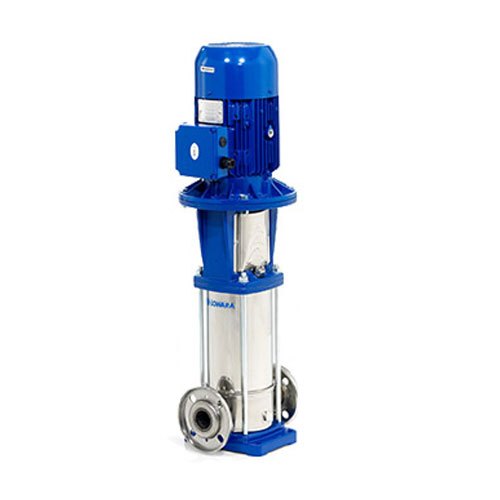
The Goulds e-SV vertical multistage pump is widely suited to water pressure booster systems where reliable flow and higher discharge pressure are required. Its vertical multistage construction, compact footprint and broad hydraulic range make it suitable for booster applications in residential buildings, commercial properties, hotels and industrial water systems.
Goulds Water Technology, a Xylem brand, identifies pressure boosting and water supply systems as key applications for the e-SV series. The pump can also be integrated with variable-speed control to respond to changing water demand.
Why Use Goulds e-SV Pumps for Booster Systems?
A booster pump system is designed to increase and maintain water pressure when the incoming supply pressure is insufficient.
This is particularly important in multi-storey buildings, where the pump must overcome building height, pipe friction and still maintain sufficient pressure at the highest or most hydraulically remote outlets.
The e-SV is a non-self-priming vertical multistage centrifugal pump. Multiple impeller stages progressively increase the pressure as water travels through the pump.
This makes the e-SV particularly useful where relatively high pressure is required without occupying excessive plant-room floor space.
Applications of Goulds e-SV Booster Pumps
Goulds e-SV pumps can be considered for booster systems serving:
- Residential buildings
- Villas
- Apartment buildings
- Hotels
- Commercial buildings
- Hospitals
- Schools
- Shopping centres
- Office buildings
- Industrial facilities
- Water treatment systems
- General water-transfer installations
The final pump configuration should always be selected according to the actual hydraulic requirements of the project.
How Does an e-SV Booster Pump System Work?
A booster system typically consists of one or more pumps connected to a common suction and discharge manifold.
When water demand increases, system pressure begins to fall. The controller responds by starting a pump or increasing pump speed.
When demand decreases, the controller reduces pump output or stops pumps as required.
A typical system may include:
Goulds e-SV pumps → Motors → Suction manifold → Discharge manifold → Check valves → Isolation valves → Pressure sensors → Pressure vessel → Control panel/VFD
The exact arrangement depends on project requirements.
Single Goulds e-SV Booster Pump
A single e-SV pump can be used where one pump is capable of satisfying the complete design flow and pressure requirement.
For example:
Required flow: 10 m³/h
Required head: 60 m
A suitable e-SV configuration would be selected from the manufacturer’s performance curves to provide approximately:
10 m³/h @ 60 m
A single-pump arrangement can be relatively simple, but it does not provide the same redundancy as a properly designed multi-pump system.
Twin Goulds e-SV Booster Pump System
Two e-SV pumps can be installed in parallel for applications requiring additional capacity, staged operation or standby capability.
Depending on the design, the system can operate as:
Duty + Standby
or
Duty + Assist
Duty + Standby
One pump handles the required duty while the second remains available as standby.
The controller can alternate the duty pump to balance operating hours.
Duty + Assist
One pump operates during normal demand. When demand increases beyond its capacity, the second pump starts and both pumps operate together.
This arrangement is useful where water consumption varies considerably throughout the day.
Three-Pump Goulds e-SV Booster System
Larger buildings may use three or more e-SV pumps connected in parallel.
For example, consider a building with a design requirement of:
Total Flow: 45 m³/h
Total Head: 70 m
A possible system concept could divide the flow between multiple pumps.
For illustration:
Pump 1: 15 m³/h @ 70 m
Pump 2: 15 m³/h @ 70 m
Pump 3: 15 m³/h @ 70 m
However, the actual pump quantity and individual pump duty should be determined from simultaneous demand, required redundancy, control philosophy and the manufacturer’s pump curves.
Simply dividing total flow equally is not always the correct final selection.
Goulds e-SV Booster Pumps with VFD
Variable Frequency Drive control can be particularly useful for booster systems because building water demand is rarely constant.
During periods of low consumption, operating every pump at full speed would generally be unnecessary.
A VFD-controlled system can vary pump speed according to pressure demand.
A pressure sensor continuously monitors discharge pressure.
When pressure falls:
Demand increases → Pump speed increases
When pressure rises:
Demand decreases → Pump speed decreases
This allows the system to maintain a target pressure while adapting to changing demand.
Xylem also offers variable-speed control solutions for Goulds Water Technology pumps, including Hydrovar and Aquavar control technologies.
Benefits of Variable-Speed Booster Systems
A correctly designed variable-speed booster system can provide:
- More consistent water pressure
- Reduced unnecessary pump operation
- Lower energy consumption under partial load
- Reduced mechanical stress
- Smoother pump starting
- Improved system control
- Automatic response to changing demand
- Better operating flexibility
The actual energy saving depends on system characteristics, operating profile, pump selection and control strategy.
How to Select a Goulds e-SV Pump for a Booster System
The two most important starting parameters are:
Flow Rate
Flow represents how much water the building requires.
It is normally expressed as:
m³/h, L/s or L/min
The required flow should be based on calculated simultaneous demand rather than simply adding every fixture’s maximum flow.
Total Dynamic Head
The pump must also provide sufficient pressure to overcome the complete system head.
A simplified calculation is:
Total Dynamic Head = Static Head + Required Residual Pressure + Friction Losses
For example:
Static height = 40 m
Required outlet pressure = 3 bar ≈ 30.6 m
Pipe and fitting losses = 8 m
Therefore:
TDH = 40 + 30.6 + 8
TDH ≈ 78.6 m
If the required flow is 20 m³/h, the design duty would therefore be approximately:
20 m³/h @ 79 m
The Goulds e-SV model should then be selected using the appropriate pump performance curve.
Why Building Height Matters
Building height has a major effect on booster pump head.
Approximately:
10.2 metres of water column ≈ 1 bar
Therefore, if the pump has to deliver water 50 metres vertically, the static component alone is approximately 4.9 bar.
But this is not the complete pump pressure requirement.
You must also consider:
- Required pressure at the highest outlet
- Pipe friction losses
- Valve and fitting losses
- Equipment pressure losses
- Suction conditions
This is why selecting a booster pump based only on the number of building floors can lead to incorrect sizing.
Importance of the Pressure Vessel
A pressure vessel can form an important part of a booster pump system.
Depending on the system design, it can help:
- Reduce unnecessary pump cycling
- Absorb small changes in water demand
- Stabilize system pressure
- Reduce pressure fluctuations
- Provide a small volume of stored pressurized water
The vessel should be selected and pre-charged according to the system design and operating pressure.
An incorrectly sized or incorrectly charged pressure vessel can result in frequent pump starting and unstable pressure.
Goulds e-SV Pump Performance Range
The e-SV family covers a broad hydraulic range, allowing different configurations to be selected according to required flow and head.
This makes it possible to use e-SV pumps across applications ranging from smaller water-pressure systems to considerably larger commercial and industrial installations.
The exact pump should always be selected from the manufacturer’s current performance data rather than simply choosing an e-SV model based on motor power.
Common Booster Pump Selection Mistakes
Selecting the Pump by Motor kW
Motor power alone does not define pump performance.
Always establish:
Flow + Head → Pump selection → Motor requirement
rather than:
Motor kW → Pump selection
Oversizing the Pump
A larger pump is not automatically better.
Oversizing can contribute to:
- Excessive pressure
- Higher energy consumption
- Unnecessary throttling
- Increased cycling
- Noise and vibration
- Operation away from the preferred hydraulic range
Ignoring Friction Loss
Building height alone does not represent total dynamic head.
Pipework, valves, fittings and other components create additional resistance.
Ignoring Suction Conditions
Even a correctly selected discharge duty can perform poorly if the suction arrangement is inadequate.
Available NPSH, suction pipe sizing, tank level and other suction conditions should therefore be checked.
Goulds e-SV Booster Pumps for High-Rise Buildings
High-rise buildings can require significant pump head because water must be delivered vertically while maintaining sufficient residual pressure at the outlets.
Depending on building height, a project may use:
- A single booster zone
- Multiple pressure zones
- Intermediate storage tanks
- Pressure-reducing valves
- Multiple booster pump sets
Very tall buildings should not automatically be served by one extremely high-pressure booster set. System pressure ratings, lower-floor pressure, zoning and equipment limitations must all be considered.
Goulds e-SV Booster Pump Supplier in UAE
DXB Solutions LLC supplies Goulds e-SV vertical multistage pumps and booster pump solutions in the UAE for residential, commercial and industrial water systems.
Pump selection can be based on project requirements including:
- Required flow
- Total dynamic head
- Building height
- Required outlet pressure
- Number of pumps
- Duty/standby requirements
- VFD requirements
- Pressure vessel requirements
- Electrical supply
- Application
For accurate selection, provide the required flow rate, total head, application and system requirements.
The Goulds e-SV vertical multistage pump is well suited to many water pressure booster applications because its multistage hydraulic design can provide the combination of flow and pressure required by building water systems.
However, reliable booster-system performance depends on more than choosing a pump model.
The required flow, total dynamic head, suction conditions, number of pumps, redundancy philosophy, pressure vessel and control method should all be considered.
Correctly sizing these components allows a Goulds e-SV booster system to maintain reliable water pressure while operating efficiently across changing building demand. For more info contact Goulds Pump Supplier in UAE or call us at +971 4 2522966.