
Selecting the correct Goulds e-SV vertical multistage pump starts with two main hydraulic requirements: flow rate and total head. Choosing a pump only by motor power can result in insufficient pressure, excessive energy consumption, or operation outside the pump’s efficient range.
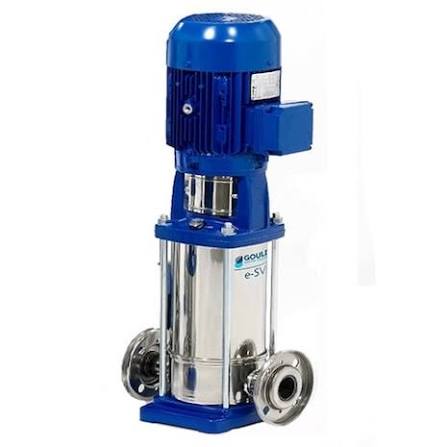
The Goulds Water Technology e-SV is a stainless-steel vertical multistage pump series, and Xylem provides selection tools that allow pumps to be selected using a specific duty point.
What Is Flow Rate?
Flow rate is the quantity of water the pump must deliver within a specific period. It is commonly expressed as:
- m³/h — cubic metres per hour
- L/s — litres per second
- L/min — litres per minute
For example, if a building requires 20 m³/h, the selected Goulds e-SV pump must be capable of delivering approximately 20 m³/h at the required system head.
Flow should be calculated from the actual demand of the application rather than simply selecting a larger pump for additional capacity.
What Is Pump Head?
Head represents the amount of energy the pump must provide to move water through the system and maintain the required pressure.
It is normally expressed in metres of water column (m).
For a typical building water-supply system, the required total dynamic head can be estimated from:
Total Head = Static Head + Required Outlet Pressure + Friction Loss
Example
Suppose a building has:
Static height: 35 m
Required pressure at the highest outlet: 2.5 bar ≈ 25.5 m
Estimated pipe and fitting losses: 8 m
Therefore:
Total Head = 35 + 25.5 + 8 = 68.5 m
The design duty point would therefore be approximately:
Flow: 20 m³/h @ Head: 68.5 m
This 20 m³/h @ 68.5 m duty point is what should be used to begin selecting the appropriate e-SV configuration.
How Flow and Head Determine the Goulds e-SV Model
Every pump has a performance curve.
The horizontal axis normally represents flow, while the vertical axis represents head. The required flow and head are plotted together to establish the duty point.
Xylem’s own pump-selection documentation demonstrates this process by entering the required total flow and total head into its selection software; the available pumps can then be compared for factors including efficiency, NPSHr, power, stages and shut-off head.
Therefore, pump selection should follow this sequence:
System requirements → Flow calculation → Head calculation → Duty point → Performance curve → e-SV model → Motor selection
Not:
Motor kW → Pump selection
Why the Number of Stages Matters
The e-SV is a multistage centrifugal pump.
Multiple impellers are arranged in stages. As water passes through successive stages, additional head is generated.
In general:
More stages → greater head capability
However, this doesn’t mean that simply choosing more stages is better. The number of stages must correspond to the required operating point.
The same principle can be seen clearly in Xylem’s published multistage performance curves, where different stage counts produce different head ranges at a given flow.
Step 1 – Determine the Required Flow
Start by calculating the maximum or design water demand.
For a booster system, this could depend on:
- Number of apartments or rooms
- Number of occupants
- Plumbing fixtures
- Simultaneous demand
- Peak water consumption
- Commercial or residential application
For an industrial system, flow should be based on the process requirement.
For irrigation, calculate the simultaneous demand of the irrigation zones that will operate together.
Step 2 – Calculate Static Head
Static head is the vertical elevation difference the pump needs to overcome.
For example:
Pump level = ground floor
Highest outlet = 40 m above pump
Static head is approximately:
40 m
Horizontal pipe length by itself does not create static head. Instead, horizontal piping contributes primarily to friction loss.
Step 3 – Determine the Required Outlet Pressure
The system may require a minimum pressure at the final outlet.
For water:
1 bar ≈ 10.2 m of water head
Therefore:
2 bar ≈ 20.4 m
2.5 bar ≈ 25.5 m
3 bar ≈ 30.6 m
4 bar ≈ 40.8 m
If the highest outlet requires 3 bar, approximately 30.6 m must be added to the static head calculation.
Step 4 – Calculate Friction Losses
Water loses pressure as it travels through:
- Pipes
- Elbows
- Tees
- Valves
- Check valves
- Strainers
- Meters
- Heat exchangers
- Other system components
Friction loss depends strongly on pipe diameter, flow velocity, pipe material and total equivalent length.
This is why simply knowing the building height isn’t enough to select an e-SV pump.
Step 5 – Calculate Total Dynamic Head
Suppose a system requires:
| Requirement | Head |
|---|---|
| Static head | 45 m |
| Required outlet pressure | 30 m |
| Pipe/fitting losses | 10 m |
| Total Dynamic Head | 85 m |
If calculated flow is 25 m³/h, your required duty becomes:
25 m³/h @ 85 m TDH
Now you have the two most important figures needed for pump selection.
Step 6 – Check the Goulds e-SV Performance Curve
Find 25 m³/h on the flow axis.
Then find 85 m on the head axis.
The intersection represents the required operating point.
You then identify an e-SV configuration whose performance curve passes appropriately through that operating region.
Xylem also provides Goulds Water Technology pump sizing and selection software for multistage pumps.
Xylem Goulds Water Technology Pump Selection & Sizing Tools
Step 7 – Consider Pump Efficiency
Don’t select a pump merely because its curve can reach the required flow and head.
The operating point should ideally fall in an efficient and manufacturer-recommended operating region.
A poorly selected oversized pump can lead to:
- Higher electricity consumption
- Excessive pressure
- Noise and vibration
- Throttling losses
- Increased component wear
- Unstable operation
Likewise, an undersized pump may fail to provide the required flow and pressure.
Step 8 – Check NPSH
Suction conditions must also be considered.
The system must provide sufficient Net Positive Suction Head Available (NPSHa) compared with the pump’s required NPSH under the applicable operating conditions.
Xylem’s pump-selection output includes NPSHr as one of the parameters used when evaluating candidate pump selections.
Poor suction conditions can contribute to cavitation, noise, vibration, loss of performance and pump damage.
Step 9 – Select the Motor
Only after determining the hydraulic requirement and suitable pump configuration should the required motor power be confirmed.
For example, a customer may request:
“I need a 7.5 kW vertical multistage pump.”
That information alone isn’t sufficient.
A better request is:
Required flow: 20 m³/h
Required head: 75 m
Liquid: Clean water
Supply: 3-phase, 50 Hz
From there, the appropriate e-SV hydraulic configuration and motor can be evaluated.
Selecting an e-SV for a Booster Pump System
For a building booster system, don’t automatically assume one pump must handle the entire maximum demand.
Depending on the design, multiple e-SV pumps can operate in parallel.
For example:
Required system duty: 45 m³/h @ 70 m
A multi-pump booster arrangement could divide the required flow among several pumps, with pumps staged according to demand. The actual number, individual pump duty, standby philosophy and control strategy should be determined from the project requirements.
Variable-speed control can also allow the system to adjust pump operation as demand changes.
Information Required for Goulds e-SV Pump Selection
For accurate selection, provide:
Flow: ___ m³/h
Total head: ___ m
Liquid: ___
Liquid temperature: ___ °C
Application: ___
Suction condition: ___
Power supply: ___ V / 50 Hz
Control: Fixed speed / VFD
Number of pumps: ___
With this information, the required operating point can be checked against the appropriate Goulds e-SV performance data.
Goulds e-SV Pump Supplier in UAE
DXB Solutions LLC supplies Goulds e-SV vertical multistage pumps in the UAE for water-transfer, pressure-boosting, commercial-building and industrial applications.
Pump selection can be carried out according to the project’s required flow and total dynamic head, along with suction conditions, liquid characteristics, motor requirements and control philosophy. For more info contact Goulds Pump Supplier in UAE or call us at +971 4 2522966.