
Correct end suction pump sizing is essential for achieving the required water flow, pressure, efficiency and reliable operation. Selecting a pump only by motor horsepower or discharge size can result in poor performance, excessive energy consumption and premature equipment failure.
The three most important parameters when sizing an end suction pump are:
- Flow rate
- Pump head
- Motor power
However, proper selection also requires consideration of the pump curve, efficiency, NPSH, pipe friction, liquid characteristics and operating conditions.
This guide explains how to determine the appropriate end suction pump size for residential, commercial, HVAC and industrial applications.
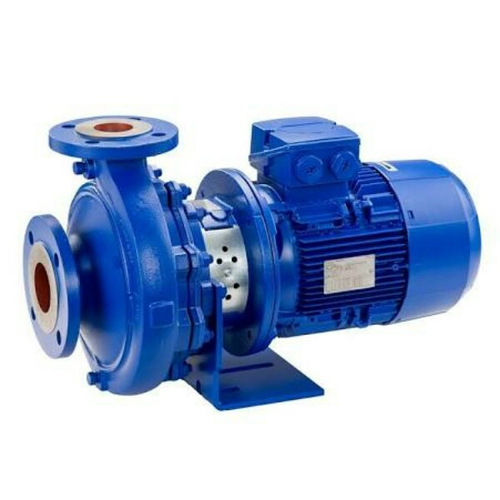
What Is End Suction Pump Sizing?
End suction pump sizing is the process of selecting a pump that can deliver the required flow rate at the required total head while operating efficiently and safely.
The basic selection point can be expressed as:
Required Flow = Q
Required Head = H
For example:
Q = 30 m³/h
H = 35 m
The selected end suction pump should be capable of delivering approximately 30 m³/h at 35 m head.
The motor power is then determined based on the hydraulic power required and the pump’s efficiency.
Step 1: Determine the Required Flow Rate
Flow rate is the amount of water that needs to be moved through the system.
Common units include:
- m³/h
- L/s
- L/min
Converting Flow Units
Useful conversions include:
1 L/s = 3.6 m³/h
1 m³/h = 0.278 L/s
For example:
10 L/s × 3.6 = 36 m³/h
Therefore, a system requiring 10 L/s needs approximately 36 m³/h of flow.
How to Determine Required Flow
The required flow depends on the application.
For a building, flow may be determined from:
- Number of occupants
- Fixture units
- Peak water demand
- Storage tank capacity
- Simultaneous demand
For HVAC systems, flow is typically related to the cooling or heating load and required temperature difference.
For irrigation, flow depends on the irrigation zones and water requirements.
For industrial applications, flow is generally determined by the process requirement.
The pump should therefore be sized according to the actual system demand, rather than simply selecting the largest available pump.
Step 2: Calculate Total Pump Head
After determining flow, calculate the total head required.
The total dynamic head (TDH) can generally be considered as:
TDH = Static Head + Friction Losses + Equipment Losses + Required Pressure Head
Static Head
Static head is the vertical elevation the pump needs to overcome.
For example, if water needs to be transferred from a tank at ground level to a tank 25 metres higher:
Static Head = 25 m
Friction Head
Water loses energy as it flows through pipes and fittings.
Friction losses occur because of:
- Pipe length
- Pipe diameter
- Pipe material
- Flow velocity
- Elbows
- Tees
- Valves
- Strainers
- Check valves
Longer and smaller pipes generally produce greater friction losses.
Equipment Losses
Additional pressure losses may occur through:
- Filters
- Heat exchangers
- Cooling equipment
- Water meters
- Control valves
- Other system components
These losses must be included in the pump head calculation.
Step 3: Convert Required Pressure to Head
Pressure and head are related.
For water, a useful approximation is:
1 bar ≈ 10.2 metres of water head
Therefore:
2 bar ≈ 20.4 m head
3 bar ≈ 30.6 m head
5 bar ≈ 51 m head
If a system requires 3 bar of pressure at the discharge point, approximately 30.6 metres of additional head may be required, depending on the system arrangement.
For accurate pump sizing, pressure requirements should be incorporated into the complete hydraulic calculation.
Step 4: Calculate the Total Dynamic Head
Consider a simplified example:
- Static elevation = 20 m
- Pipe friction losses = 8 m
- Valve and fitting losses = 3 m
- Equipment losses = 2 m
- Required outlet pressure = 2 bar ≈ 20.4 m
Therefore:
TDH = 20 + 8 + 3 + 2 + 20.4
TDH = 53.4 m
The required pump duty point would therefore be approximately:
Flow = Required system flow
Head = 53.4 m
The actual design should use detailed hydraulic calculations rather than relying on a simplified estimate.
Step 5: Identify the Pump Duty Point
The pump duty point is the required combination of flow and head.
For example:
Flow = 40 m³/h
Head = 45 m
This means the selected end suction pump must deliver 40 m³/h at 45 m head.
This point should be checked against the manufacturer’s pump performance curve.
Step 6: Use the Pump Performance Curve
The pump curve is one of the most important documents for selecting an end suction pump.
A typical pump curve shows the relationship between:
Flow ↔ Head
It may also provide:
- Efficiency
- Motor power
- NPSH required
- Impeller diameter
- Operating range
Do not select an end suction pump simply because its maximum flow is higher than the required flow.
For example, a pump may have a maximum flow of 60 m³/h but may provide only 25 m head at that flow.
If the system requires 40 m³/h at 45 m head, that pump would not be suitable.
Step 7: Select a Pump Near Its Best Efficiency Point
The Best Efficiency Point (BEP) is the area where the pump operates most efficiently.
Whenever practical, the design duty point should be reasonably close to the pump’s recommended operating region.
Operating too far from the preferred range can contribute to:
- Lower efficiency
- Increased vibration
- Higher mechanical loads
- Increased energy consumption
- Reduced component life
The manufacturer should be consulted for the recommended operating range of the selected pump.
Step 8: Calculate Motor Power
Once flow, head and efficiency are known, the approximate hydraulic power can be calculated.
For water:
P = ρ × g × Q × H / η
Where:
- P = shaft/motor power requirement in watts, depending on how efficiency is applied
- ρ = water density, approximately 1000 kg/m³
- g = 9.81 m/s²
- Q = flow rate in m³/s
- H = total head in metres
- η = relevant efficiency
Example Motor Power Calculation
Suppose:
Flow = 40 m³/h
Convert flow to m³/s:
40 ÷ 3600 = 0.0111 m³/s
Assume:
Head = 40 m
Pump efficiency = 75%
Then:
P = 1000 × 9.81 × 0.0111 × 40 ÷ 0.75
The calculated power is approximately:
5.81 kW
The next appropriate standard motor size may therefore be selected based on the manufacturer’s pump and motor combination, operating margin and actual duty conditions.
Do not automatically select the motor size solely from this calculation. The final motor selection should be confirmed against the manufacturer’s data.
Step 9: Understand Pump Efficiency
Pump efficiency has a direct effect on motor power requirements.
For the same flow and head:
Higher efficiency → Lower required input power
For example, if two pumps provide the same flow and head but one operates at a higher efficiency, it can require less electrical power.
For pumps operating continuously, even relatively small efficiency differences can result in significant energy savings over the pump’s service life.
Step 10: Check NPSH
NPSH is another important consideration when sizing an end suction pump.
The system’s NPSH Available (NPSHa) should be sufficiently greater than the pump’s NPSH Required (NPSHr).
Insufficient NPSH can result in cavitation.
Possible symptoms include:
- Abnormal noise
- Vibration
- Reduced performance
- Impeller damage
- Unstable operation
Suction pipe design, water temperature, tank level and atmospheric pressure can all affect NPSH.
Step 11: Check the Suction Pipe
Suction conditions are particularly important for end suction centrifugal pumps.
Check:
- Suction pipe diameter
- Pipe length
- Number of bends
- Valve arrangement
- Strainers
- Water level
- Suction lift
- Available NPSH
The suction arrangement should minimize unnecessary friction and turbulence.
A pump that is correctly sized hydraulically can still perform poorly if its suction conditions are inadequate.
Step 12: Consider the Pumped Liquid
Standard end suction pumps are commonly used for clean water, but the pumped liquid should always be identified before final selection.
Consider:
- Temperature
- Density
- Viscosity
- Corrosiveness
- Chemical content
- Suspended solids
The material of construction and mechanical seal may need to be changed for different liquids.
Step 13: Consider the Operating Schedule
Pump sizing should also take into account how frequently the pump operates.
Consider whether the pump operates:
- Continuously
- Several hours per day
- Intermittently
- Only during peak demand
For continuous-duty applications, efficiency and reliability become particularly important.
For variable-demand systems, a VFD or multiple-pump arrangement may provide better control.
End Suction Pump Sizing Example
Consider a commercial water-transfer application with the following requirements:
Required flow: 50 m³/h
Static head: 25 m
Pipe friction: 10 m
Fittings and valves: 4 m
Equipment losses: 3 m
Required outlet pressure: 1.5 bar
Convert pressure to head:
1.5 × 10.2 ≈ 15.3 m
Therefore:
Total Head = 25 + 10 + 4 + 3 + 15.3
Total Head ≈ 57.3 m
The required duty point is therefore approximately:
50 m³/h at 57 m head
The engineer or pump supplier would then select an end suction pump whose performance curve provides this duty point within an appropriate operating range.
The final motor size would be selected after checking the pump efficiency and manufacturer’s motor recommendation.
Common End Suction Pump Sizing Mistakes
1. Selecting the Pump by Horsepower
Motor horsepower alone does not determine pump performance.
A pump’s flow and head must match the system requirement.
2. Ignoring Pipe Friction
Even a powerful pump may fail to deliver the expected flow if pipe friction losses have been underestimated.
3. Ignoring Required Pressure
If the system needs a specific pressure at the outlet, this pressure must be converted into the equivalent head and included in the calculation.
4. Oversizing the Pump
An oversized pump may:
- Consume excessive energy
- Produce excessive pressure
- Operate away from BEP
- Increase wear
- Require throttling
5. Undersizing the Pump
An undersized pump may fail to provide the required flow or pressure.
6. Ignoring NPSH
Insufficient NPSH can cause cavitation and damage.
7. Selecting from Maximum Flow
Maximum pump flow is not the same as the required operating flow.
Always check the pump curve at the actual duty point.
End Suction Pump Sizing for Different Applications
Residential Buildings
Sizing may be based on:
- Peak water demand
- Building height
- Number of fixtures
- Storage tank arrangement
- Required pressure
Commercial Buildings
Commercial systems may require:
- Higher flow
- Duty/standby pumps
- Pressure boosting
- Automation
- VFD control
HVAC Systems
Pump sizing depends on:
- Cooling/heating load
- Required water flow
- System resistance
- Chiller pressure drop
- Pipe friction
Industrial Applications
Industrial pump sizing may require detailed information about:
- Process flow
- Operating pressure
- Fluid characteristics
- Temperature
- Continuous operation
- Material compatibility
End Suction Pump Selection Checklist
Before purchasing an end suction pump, confirm:
- Required flow rate
- Static head
- Pipe friction losses
- Valve and fitting losses
- Equipment losses
- Required discharge pressure
- Total Dynamic Head
- Pump duty point
- Pump efficiency
- Motor power
- NPSH requirements
- Pumped liquid
- Material of construction
- Mechanical seal
- Electrical supply
- Operating hours
- Duty/standby requirements
- VFD requirement
- Pump dimensions and connections
Why Professional Pump Sizing Matters
Correct pump sizing can help achieve:
- Reliable water flow
- Required pressure
- Better energy efficiency
- Reduced vibration
- Lower operating costs
- Longer equipment life
- Reduced maintenance requirements
For commercial and industrial installations, pump selection should ideally be based on a proper hydraulic calculation and the manufacturer’s pump performance data.
End Suction Pump Supplier in UAE
If you are looking for an end suction pump supplier in UAE, DXB Solutions LLC can assist with pump selection for residential, commercial, HVAC, irrigation and industrial applications.
The required flow, head, liquid type, operating conditions and electrical requirements should be provided so that the appropriate pump can be selected.
A properly sized end suction pump can provide reliable performance while helping reduce unnecessary energy consumption and maintenance costs. For more info contact Water Pump Suppliers in UAE or call us at +971 4 2522966.