
Choosing the right end suction pump is essential for achieving reliable water flow, adequate pressure, efficient operation and long service life. End suction centrifugal pumps are widely used in commercial buildings, HVAC systems, irrigation, water transfer and industrial applications.
However, selecting a pump based only on motor power or pipe size can result in poor performance and unnecessary operating costs.
The correct pump should be selected based on flow rate, total head, operating point, liquid characteristics, system design, motor requirements and operating conditions.
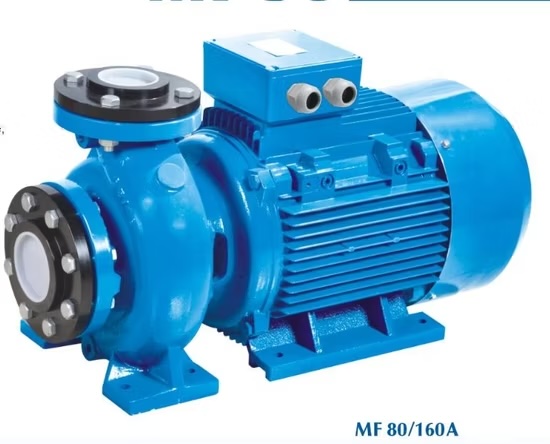
What Is an End Suction Pump?
An end suction pump is a type of centrifugal pump in which the liquid enters the pump through the suction connection and exits through the discharge connection.
The pump uses a rotating impeller to transfer energy to the liquid and generate flow and pressure.
End suction pumps are commonly used for:
- Water transfer
- Building water supply
- HVAC systems
- Chilled-water circulation
- Cooling systems
- Irrigation
- Industrial water circulation
- General-purpose water pumping
- Commercial water systems
Their relatively simple construction makes them a popular choice for many clean-water applications.
1. Determine the Required Flow Rate
The first step in selecting an end suction pump is determining the required flow rate.
Flow rate indicates how much water the pump needs to deliver and is commonly measured in:
- m³/h
- L/s
- L/min
For example, if a system requires 30 m³/h, the selected pump should be capable of delivering approximately 30 m³/h at the required operating head.
Do not select a pump based only on its maximum flow capacity. The pump must deliver the required flow at the required head.
2. Calculate the Required Pump Head
Pump head is one of the most important factors in pump selection.
Total Dynamic Head (TDH) can include:
- Static elevation
- Pipe friction losses
- Fittings and valves
- Equipment losses
- Required discharge pressure
- Other system resistance
A simplified approach is:
Total Head = Static Head + Friction Losses + Required Pressure Head
The selected pump should provide the required flow at this total head.
Why Pump Head Matters
Suppose a pump is advertised as capable of producing a high flow rate, but that flow is available only at a very low head.
If your system requires a significantly higher head, the actual flow may be much lower.
Therefore, always select an end suction pump using its performance curve, rather than relying only on the pump’s maximum flow or motor horsepower.
3. Identify the Pump Operating Point
The operating point is the point where the pump performance curve intersects the system curve.
It represents the actual combination of:
Flow + Head
For example:
30 m³/h at 35 m head
This operating point should fall within a suitable region of the pump’s performance curve.
Selecting a pump that operates close to its Best Efficiency Point (BEP) is generally desirable because it can provide better efficiency and reduce mechanical stress.
4. Check the Pump Curve
The manufacturer’s pump curve provides important information about pump performance.
A typical pump curve can show:
- Flow rate
- Head
- Efficiency
- Motor power
- NPSH required
- Different impeller diameters
For example, if your design requirement is:
Flow = 25 m³/h
Head = 30 m
Locate this point on the pump curve and verify that the selected pump can operate at the required duty point.
A professional end suction pump supplier in UAE should be able to provide the relevant pump curve before final selection.
5. Select the Correct Motor Power
Motor power should be selected according to the pump’s hydraulic requirements.
Motor power depends on factors such as:
- Flow
- Head
- Pump efficiency
- Liquid density
- Operating conditions
A simplified hydraulic relationship is:
P = ρ × g × Q × H / η
Where:
- P = required power
- ρ = liquid density
- g = gravitational acceleration
- Q = flow rate
- H = total head
- η = pump efficiency
The actual motor selection should also account for appropriate operating margins and manufacturer recommendations.
Choosing an unnecessarily large motor can increase equipment and operating costs, while an undersized motor may overload during operation.
6. Consider the Pumped Liquid
Not all end suction pumps are suitable for every liquid.
Before selecting the pump, identify:
- Liquid type
- Temperature
- Viscosity
- Density
- Chemical characteristics
- Presence of solids
- Corrosiveness
For normal clean-water applications, standard materials may be suitable.
For corrosive or aggressive fluids, different materials may be required.
If the liquid contains significant suspended solids, a conventional clean-water end suction pump may not be the appropriate choice.
7. Check the Required Materials
Pump construction materials affect durability and compatibility.
Common materials include:
- Cast iron
- Stainless steel
- Bronze
- Special alloys
The appropriate material depends on the pumped liquid and operating environment.
For standard building water applications, a cast-iron pump may be suitable. For more demanding applications, stainless steel or other corrosion-resistant materials may be required.
8. Check NPSH Requirements
Net Positive Suction Head (NPSH) is an important consideration when selecting an end suction pump.
The available NPSH in the system should be greater than the pump’s required NPSH, with an appropriate margin.
Insufficient NPSH can contribute to cavitation.
Cavitation can result in:
- Noise
- Vibration
- Reduced performance
- Impeller damage
- Premature pump failure
Suction pipe design, water temperature, static water level and pressure conditions should therefore be considered during pump selection.
9. Consider Suction Conditions
End suction pumps can be sensitive to poor suction conditions.
Consider:
- Suction pipe diameter
- Suction pipe length
- Number of bends
- Valve arrangement
- Water level
- Suction lift
- Available NPSH
The suction pipe should generally be designed to minimize unnecessary friction losses and turbulence.
Poor suction conditions can cause unstable operation and increase the risk of cavitation.
10. Check Pipe Size and Connections
The pump connection size should not automatically determine the required pipe size.
The complete piping system should be evaluated based on:
- Required flow
- Flow velocity
- Pressure losses
- Pipe length
- Installation arrangement
Reducing pipe size excessively can increase friction losses and affect pump performance.
The supplier should verify the pump’s suction and discharge connection sizes against the actual piping design.
11. Consider Duty and Standby Requirements
For critical commercial and industrial applications, a single pump may not provide sufficient operational security.
A system may require:
1 Duty + 1 Standby
or
2 Duty + 1 Standby
The exact arrangement depends on the application’s water demand and reliability requirements.
Duty/standby configurations are commonly considered for:
- Hotels
- High-rise buildings
- Commercial buildings
- Industrial facilities
- Water treatment systems
The standby pump can provide backup capacity if the duty pump is unavailable.
12. Consider Variable-Speed Operation
A Variable Frequency Drive (VFD) can adjust pump speed according to system demand.
VFD-controlled systems can be useful where flow requirements vary significantly.
Potential benefits include:
- Better pressure control
- Reduced energy consumption
- Reduced starting current
- Improved system control
- Reduced unnecessary pumping
However, VFD selection and control settings should be matched correctly to the pump, motor and system.
13. Check Pump Efficiency
Energy efficiency is particularly important for pumps that operate for long periods.
Two pumps may provide similar flow and head but have different efficiencies.
A more efficient pump can reduce electricity consumption over its operating life.
When comparing pumps, consider:
Purchase Price + Installation Cost + Energy Cost + Maintenance Cost + Expected Service Life
rather than looking only at the initial purchase price.
14. Consider the Operating Environment in UAE
When selecting an end suction pump for installation in the UAE, the surrounding environment should also be considered.
Depending on the installation, factors may include:
- High ambient temperatures
- Dust
- Humidity
- Outdoor installation
- Electrical conditions
- Ventilation
- Pump room conditions
The motor and electrical equipment should be appropriate for the actual installation environment.
15. Choose a Reliable Pump Brand
The pump manufacturer is another consideration when selecting equipment.
Established manufacturers can provide:
- Detailed pump curves
- Technical documentation
- Spare parts
- Replacement components
- Service support
- Product availability
The best brand is not necessarily the same for every application.
Pump selection should be based on the technical requirements, product quality, efficiency, availability and long-term support.
Common Mistakes When Selecting an End Suction Pump
Avoid these common mistakes:
Selecting by Motor Horsepower Only
A 10 HP pump is not automatically suitable simply because the system requires approximately 10 HP.
The pump must match the required flow and head.
Selecting the Maximum Flow Pump
Maximum flow is not necessarily the actual operating flow.
Always check the pump curve at the required head.
Ignoring Friction Losses
Long pipes, bends, valves and fittings can create significant pressure losses.
Ignoring NPSH
Poor suction conditions can lead to cavitation and pump damage.
Oversizing the Pump
An oversized pump can operate away from its optimum operating region and consume more energy than necessary.
Choosing Only on Initial Price
A cheaper pump may have higher energy consumption or maintenance costs over its lifetime.
End Suction Pump Selection Example
Consider a commercial water-transfer application requiring:
Required flow: 40 m³/h
Required head: 35 m
Liquid: Clean water
The selection process would be:
Step 1: Identify the required flow — 40 m³/h.
Step 2: Calculate the total dynamic head — 35 m.
Step 3: Identify pumps capable of operating around 40 m³/h at 35 m head.
Step 4: Compare the available pump curves.
Step 5: Check the operating point and efficiency.
Step 6: Verify NPSH requirements.
Step 7: Confirm motor power.
Step 8: Check materials and mechanical seal compatibility.
Step 9: Confirm suction and discharge connections.
Step 10: Select the pump that provides the required performance with suitable efficiency and operating margins.
The final pump model should always be confirmed using the manufacturer’s technical data and the actual system design.
End Suction Pump Applications
End suction pumps are widely used in:
- Commercial buildings
- Residential developments
- Hotels
- HVAC systems
- Chilled-water systems
- Cooling systems
- Irrigation systems
- Industrial plants
- Water transfer systems
- General water supply
For specialized applications involving sewage, drainage, heavily contaminated water or large suspended solids, another pump design may be more appropriate.
Why Choose a Professional End Suction Pump Supplier?
An experienced supplier can help with more than simply supplying the pump.
A professional pump supplier can assist with:
- Pump selection
- Flow and head calculations
- Pump curve analysis
- Motor selection
- Material selection
- Pump set configuration
- VFD selection
- Installation
- Commissioning
- Spare parts
- Maintenance
This is particularly valuable for MEP contractors, consultants, facility managers and industrial customers.
End Suction Pumps in UAE
End suction pumps are widely used across the UAE for commercial, residential, HVAC, irrigation and industrial applications.
When purchasing an end suction pump in Dubai or elsewhere in the UAE, customers should compare the pump’s technical performance, efficiency, construction materials, warranty, spare-parts availability and after-sales support.
DXB Solutions LLC supplies water pumps and pumping solutions for residential, commercial and industrial applications across the UAE. Customers can contact the company with their required flow, head, application and operating conditions to identify a suitable pump. For more info contact Water Pump Suppliers in UAE or call us at +971 4 2522966.