
Choosing the right Ariston solar water heater in the UAE requires more than selecting a tank capacity. The correct system should be based on daily hot-water demand, number of users, application, available installation space, solar collector arrangement, water quality, operating pressure and backup heating requirements.
In the UAE, abundant sunshine makes solar water heating particularly relevant for villas, residential buildings, hotels and other properties with regular hot-water demand. However, proper sizing and installation are essential for achieving reliable hot-water availability and efficient operation.
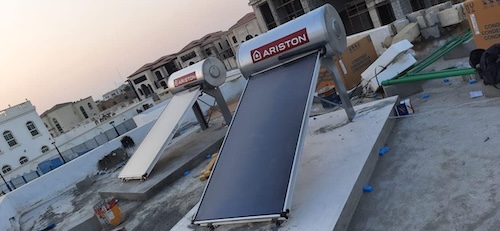
What Is an Ariston Solar Water Heater?
An Ariston solar water heating system uses energy from sunlight to heat water for domestic or commercial use.
A typical solar water heating installation consists of:
- Solar collector
- Hot-water storage tank
- Insulated piping
- Safety and control components
- Valves and fittings
- Backup heating, where applicable
Solar energy is collected during daylight hours and transferred to the water, which is then stored for use when required.
The exact configuration varies between Ariston product ranges and system designs, so the manufacturer’s specifications should always be checked for the particular model being considered.
Why Consider a Solar Water Heater in the UAE?
The UAE receives substantial solar radiation throughout the year, making solar thermal systems practical for many hot-water applications.
A properly designed solar water heater can reduce reliance on conventional electrical water heating during periods when sufficient solar energy is available.
Solar water heaters can be considered for:
- Villas
- Residential buildings
- Apartments
- Hotels
- Hospitals
- Schools
- Labour accommodation
- Staff accommodation
- Commercial properties
- Industrial facilities
The suitability and expected energy savings depend on hot-water consumption, installation conditions and system design.
1. Determine Your Daily Hot-Water Requirement
The first step is to understand how much hot water is actually required.
Don’t select a solar water heater simply because a particular tank size is popular.
Consider:
Number of users × Hot-water consumption per person × Usage pattern
Hot-water consumption can vary significantly depending on shower duration, number of bathrooms, kitchen use and user behaviour.
For example, a villa with six occupants and several bathrooms may require considerably more stored hot water than a two-person household.
2. Select the Appropriate Tank Capacity
Solar water heater tanks are available in different capacities.
Common residential sizes can include:
150 litres – smaller hot-water requirements
200 litres – medium residential requirements
300 litres – larger household requirements
Larger capacities and engineered systems may be appropriate for commercial applications.
However, these should not be treated as fixed person-to-litre rules. Actual sizing depends on daily consumption and the amount of hot water required during peak periods.
For example, two households with four occupants can have very different hot-water requirements.
3. Consider the Number of Bathrooms
The number of bathrooms is another important consideration.
A villa with:
- 4 occupants
- 1 bathroom
may have a different peak demand from a villa with:
- 4 occupants
- 4 bathrooms
If several showers may operate at approximately the same time, peak hot-water demand becomes particularly important.
Therefore, consider both:
Daily hot-water consumption
and
Peak simultaneous demand
when selecting the system.
4. Check the Solar Collector Size
Tank capacity and solar collector area need to work together.
Installing a large storage tank with insufficient collector capacity may result in inadequate solar heating.
Conversely, the collector arrangement should also be appropriate for the storage volume and UAE operating conditions.
The final collector area should therefore follow the selected Ariston system’s technical specifications and the project’s solar design.
5. Check the Installation Location
Solar collectors require suitable exposure to sunlight.
Before selecting the system, inspect the available:
- Roof area
- Collector orientation
- Shading
- Structural support
- Pipe route
- Tank location
- Maintenance access
Nearby buildings, walls, equipment or architectural structures can create shading and reduce available solar energy.
Good installation planning is therefore just as important as selecting the correct equipment.
6. Consider UAE Summer Conditions
UAE summer conditions deserve particular attention when designing a solar hot-water system.
Very high ambient temperatures combined with strong solar radiation can produce high water temperatures.
The installation should therefore incorporate the safety components and temperature-control measures specified for the particular system.
Depending on the design, these can include appropriate:
- Temperature and pressure protection
- Expansion accommodation
- Mixing/tempering arrangements
- Insulation
- System controls
Hot-water safety should never be overlooked merely because higher solar heating is available.
7. Consider Water Quality
Water quality can affect solar water heating equipment over time.
Scale accumulation can reduce heat-transfer performance and affect components exposed to hot water.
This is particularly relevant because scale formation generally becomes more significant at elevated water temperatures.
Regular inspection and appropriate maintenance can help identify:
- Scale accumulation
- Sediment
- Corrosion
- Anode condition where applicable
- Valve problems
- Collector performance issues
The maintenance requirements should follow the manufacturer’s recommendations for the particular Ariston system.
8. Check the Required Water Pressure
Before choosing a solar water heater, verify the operating pressure of the building’s water system.
This is particularly important when the property uses a booster pump system.
The solar water heater, storage tank, valves and connected components must be suitable for the system’s operating conditions.
The design should also consider pressure fluctuations and thermal expansion.
9. Consider Backup Heating
Solar energy availability varies with weather, season and usage.
If hot-water demand exceeds available solar heating, a backup heat source may be necessary.
Depending on the Ariston system configuration, supplementary heating may be incorporated or provided separately.
When selecting the system, ask:
- Is backup heating required?
- What is its rated power?
- How is it controlled?
- When does it operate?
- Can the user adjust its operation?
A correctly designed backup arrangement provides hot-water availability without unnecessarily operating conventional heating when adequate solar energy is available.
10. Choose Between Residential and Commercial Systems
A residential solar water heater and a commercial solar hot-water system should not be selected in exactly the same way.
Residential Applications
For villas and homes, selection commonly focuses on:
- Number of occupants
- Number of bathrooms
- Daily hot-water use
- Tank capacity
- Roof space
- Backup heating
Commercial Applications
For hotels, hospitals, labour camps and other high-demand facilities, sizing should be based on a more detailed demand assessment.
Commercial design can involve:
Daily demand → Peak demand → Storage capacity → Collector area → Recovery requirement → Circulation system → Backup heating
Large systems should therefore be engineered rather than selected simply according to the number of occupants.
11. Consider Hot-Water Circulation
Larger villas and commercial buildings may have long hot-water pipe runs.
Without circulation, users may need to wait while cold water in the pipe is discharged before hot water reaches the outlet.
A properly designed hot-water circulation pump can keep hot water available closer to the fixtures.
However, circulation also creates heat loss through the pipework. Good insulation and appropriate circulation control are therefore important.
12. Don’t Oversize the Solar Water Heater
Choosing a larger system isn’t automatically better.
An unnecessarily oversized system can increase:
- Initial investment
- Installation space
- Stored water volume
- Heat losses
- System complexity
Likewise, an undersized system may frequently depend on backup heating or fail to meet hot-water demand.
The goal is therefore to match the solar water heater to the actual application.
13. Consider Maintenance Before Buying
Accessibility is often overlooked during installation.
Collectors, tanks, valves and other serviceable components should be positioned so technicians can safely inspect and maintain them.
Routine maintenance may include checking:
- Solar collectors
- Storage tank
- Insulation
- Connections
- Safety valves
- Electrical backup components
- System pressure
- Water leakage
- Scale accumulation
- Circulation pump, where installed
Good maintenance access can make long-term servicing considerably easier.
14. Ariston Solar Water Heater for Villas
For a villa, start by collecting the following information:
Number of occupants: ___
Number of bathrooms: ___
Approximate daily hot-water requirement: ___ L/day
Simultaneous shower usage: ___
Available roof space: ___
Water pressure: ___ bar
Backup heating required: Yes / No
Hot-water circulation: Yes / No
With this information, an appropriate system capacity can be evaluated.
15. Ariston Solar Water Heater for Commercial Buildings
For commercial projects, additional information may be required:
- Building type
- Number of occupants/rooms
- Occupancy rate
- Daily hot-water demand
- Peak demand
- Required hot-water temperature
- Available roof area
- Existing hot-water system
- Storage requirement
- Circulation requirement
- Backup heating requirement
- Water pressure
- Installation location
This allows the solar system to be selected according to actual operating conditions rather than using a simple rule of thumb.
Common Solar Water Heater Selection Mistakes
Some common mistakes include choosing the system only by tank capacity, ignoring actual hot-water demand, insufficient collector sizing, poor collector positioning, ignoring water pressure, inadequate maintenance access, overlooking water quality and selecting a system without considering backup heating.
A properly selected system should consider the entire hot-water installation, not only the storage tank.
Ariston Solar Water Heater Supplier in UAE
DXB Solutions LLC supplies Ariston solar water heater solutions in the UAE for residential and commercial applications.
System selection can be considered according to:
- Required hot-water capacity
- Number of users
- Application
- Tank capacity
- Installation conditions
- Water pressure
- Solar collector requirements
- Backup heating requirements
- Hot-water circulation requirements
Solutions can be considered for projects across Dubai, Sharjah, Ajman, Abu Dhabi, Ras Al Khaimah, Fujairah and other locations in the UAE.
For proper selection, provide the number of users, application, approximate hot-water demand, installation location and required storage capacity.
Choosing the right Ariston solar water heater in the UAE begins with understanding the property’s actual hot-water demand.
Tank capacity is important, but it should not be considered alone. The number of users, peak demand, collector sizing, roof conditions, UAE climate, water quality, operating pressure, backup heating and maintenance requirements all influence system selection.
A properly sized solar water heating system can provide reliable hot-water availability while making effective use of available solar energy. For more info contact Ariston Solar Water Heater Suppliers in UAE or call us at +971 4 2522966